
LSD In the Netherlands

LSD, the synthetic drug that opened the minds of millions during the 60s and 70s is once again on the scene opening the minds of a new generation of Europeans. Many of the clandestine drug labs in the Netherlands that made their fortunes on Ecstasy, are now turning to making LSD in large quantities. Reasons for this vary, but supposedly there are now more restrictions on the chemicals needed to synthesize Ecstasy.

LSD is indeed available in Amsterdam, but it is considered an illegal hard drug here, and anyone possessing it, especially in quantity is subject to arrest and imprisonment. Also LSD, while not addictive is a very powerful psychedelic drug with numerous physical and psychological effects. It’s not for the faint of heart nor anyone with depression or other mental disorder.

Apparently much more of the LSD is being exported to places like Germany which has recently noted a ten-fold increase in LSD seized along the border with Holland.

Some of the LSD being manufactured in Holland is used locally by the club set who perhaps are finding Ecstasy to be less of a kick after continuous use. So you may be offered LSD in a club setting along with Ecstasy. Some of the LSD is available in sheets (blotter), but it seems certain labs are making it in a pill form, thus confusing it with Ecstasy, which also appears in pill form. BEWARE! Know what it is before you take it. The Dutch will know and will tell you (hopefully) if you ask.

Another warning – LSD is NOT a party drug! Although many younger, less experienced people will take it at a club, concert or party, they eventually learn it’s way too strong a mind fuck to experience in an unfamiliar or crowded setting. In addition its effects last at least 10-12 hours during which time you will not be “yourself.” For more info about LSD check out erowid.org, an excellent resource on mind altering drugs.

Last Warning – LSD is NOT available for sale in coffeeshops. And if you try to score from dealers on the street you WILL be ripped-off. Don’t say you weren’t warned!
Salvador Dalí and the Theater-Museum of Figueres

There are actually three museums run by the Gala-Salvador Dalí Foundation. All are in the northeast corner of Spain known as Catalonia.

Firstly, in the town of Pubol is the Gala Dalí Castle House-Museum. This castle-like mansion was designed as a tribute to Salvador’s wife Gala, a space where she could live like royalty in rooms filled with Dalí’s artworks, and uncluttered spaces suitable for the grand visions of the master.

Continue reading

Eat, Drink and Be Merry in Prague

One of the great pleasures of life is to dine well. In Prague this pleasure is considered to be part of life, not something reserved for special occasions. In fact few European capitals can claim a greater variety or more sophisticated cuisine than can be enjoyed in Prague’s hundreds of restaurants. And when you consider the low cost of dining out in Prague, you can understand why it’s so hip to visit this culinary mecca.

To start there is Czech cuisine, which like most central European food, is centered around meat and potatoes, with vegetables and excellent salads. Whether you like goulash or not, a meal in a traditional Czech restaurant is an unforgetable experience, if not a gastronomic high point. For that kind of experience you need only visit one of the many French restaurants dotting the city. From hardy French country food to Nouvelle cuisine, Prague does justice to the epicurian palate. World class restaurants serve up excellent fare, in elegant, classical surroundings. In many of these places you can easily imagine you’re in Old Europe with many restaurant buildings in the Old Town dating back 500 to 1000 years. So ambiance plays a big part in the Prague dining experience.

Continue reading

Karlovy Vary

See Karlovy Vary Hotels

West of Prague, near the German border lies several spa resort towns. The largest and most famous of these is Karlovy Vary, which has been serving the needs of health seekers since the Middle Ages. There are 12 hot springs in the area, and a huge resort complex to serve the needs of the millions of tourists (mostly German) who visit annually.

The history of the area goes back to the mid 1300s when Charles IV was impressed with the springs and the surrounding area. The springs pump out three million liters of water from 42 to 73 degrees Celsius. A variety of health restoring treatments are available including mud and peat baths. The water itself supposedly has rejuvenating effects, especially with digestive problems and metabolic disorders.

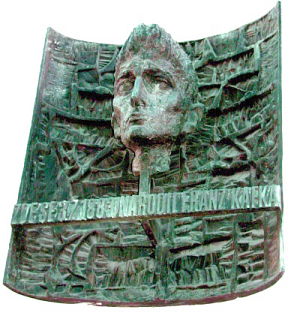
Franz Kafka Exhibition

Franz Kafka was born in the Old Town Square in Prague in 1883. The son of German/Jewish/Czech parents, he wrote exclusively in German. He was a very influential writer, and his stories dealt with faceless bureaucracy and social alientation. His most famous works are The Trial and Metamophosis.

Kafka’s work wasn’t published until after his death, then the Nazis and Communists both banned his work. Yet his books managed to strike a chord with many writers who felt he’d broken new ground with his social commentary fiction.

This exhibition displays some of Kafka’s original works and photographs from the period. It’s worth a visit to pay homage to a man who influenced so many writers (this one included!).

Location: Prague 1, U Radnice 5 (Old Town Square)
Open: Tuesday to Friday, 10am to 6pm, Saturdays 10am – 5pm Entrance Fee: 20 crowns

National Museum


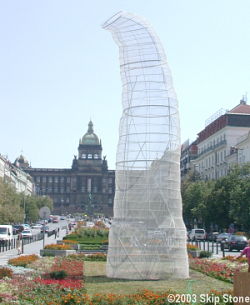
Sculpture & National Museum

The National Museum lies at one end of Wenceslas Square. It’s the oldest museum in the country, founded in 1818. The museum’s exhibitions focus on the natural history of the region. These include mineralogy, paleontology, anthropology and zoology.

Hours: Mon- Sun 10:00 – 18:00 (May-Sept.), 9:00 – 17:00 (Oct.-Apr.) Closed first Tuesday every month.
Entrance fee: adults 80 CZK, reduced fee 40 CZK, children up to 6 years of age free
Family entrance fee (max. 2 adults, total 4 persons) 90 CZK
School groups (on days of school education) each 20 CZK
Every first Monday entrance free
Location: Praha 1, Václavské náměstí 68
Website: https://www.nm.cz/english/

Toy Museum

The Toy Museum, located in the former Count’s Chambers of Prague Castle, hosts the second largest toy collection in the world. From ancient Greece to the latest, you’ll be amazed at the range of toys from Europe and America, housed on two floors. The collection includes dolls and dollhouses, toy planes, trains and cars, even robots.

Location: Prague 1, Jiřská 6
Tel. +420 224 372 294
Fax +420 224 372 295
Website:

Open daily from 9:30 am to 5 pm during the tourist season.

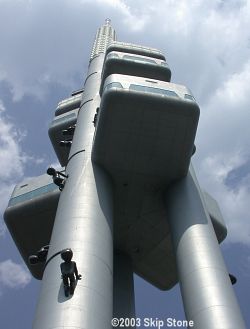
Prague TV Tower


View from foot of tower.
Note the “babies” or Miminka crawling up the poles.
It’s art by David Cerny.

Standing 474 meters tall, Prague’s TV tower is the tallest building in Prague. Located in Zizkov’s Mahler Gardens, it’s also an interesting tourist attaction. The tower was started under the communist government in 1985, but finished after the revolution in 1992. There are photos on display of the construction. Besides the stupendous views of Prague from the lookout at 97 meters, there’s also a good cafe and restaurant serving international cuisine at 63 meters. On a clear day you can see 100 km.


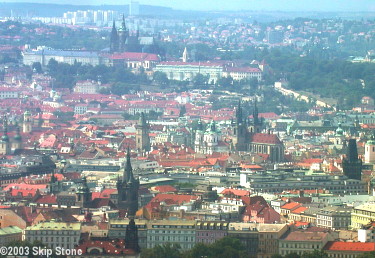
View of Old Town and Prague Castle from Lookout Cabin

The lookout cabin is open daily from 10am to 11pm.
The restaurant is open daily from 11am to 11:30 pm.
Admission to the tower and restaurant costs 150 crowns or about 5 Euros.

Address: Mahlerovy sady 1, Prague 3
Phone: 267 005 778
Fax: 222 724 014
Email: info@tower.cz
Website: https://www.tower.cz

Dutch Pharmacies Now Stock Marijuana!

As of today, September 1, 2003, Dutch pharmacies will begin legally stocking marijuana and selling it to those with cannabis prescriptions from their doctors. It can now be sold in any of the 1,650 pharmacies in the Netherlands (in addition to the 800+ coffeeshops already selling marijuana). 80 hospitals and 400 doctors will also be allowed to prescribe and dispense the drug.

High quality marijuana in it’s raw form will be available in 5 gram packets for 50 Euros. This makes the Netherlands the first country in the world to prescribe and sell cannabis since it was prohibited by UN convention (it used to be one of the most frequently prescribed drugs before prohibition).

The Netherlands has done the most extensive research into the medical and social uses of cannabis, and knows for a fact that it has many medicinal uses including helping AIDS and Multiple Sclerosis patients. The government’s Bureau for Medicinal Cannabis (BMC) has been researching the effect of the drug on patients, and is the agency charged with overseeing the production and distribution of medical cannabis in the Netherlands.

The Dutch amended their Opium Law to allow the prescription and distribution of cannabis through pharmacies. Two growers will supply the pharmacies with medicinal grade marijuana.

Of course patients can also visit any of over 800 coffeeshops that also sell marijuana, but of course if they do, they’ll have to pay for it, whereas if they get a prescription it’s hoped their insurance will cover most of the cost. The public insurers will decide soon whether to cover cannabis as just another pharmacy drug.

The Netherlands has led the world in allowing people the freedom to use soft drugs such as marijuana and hashish without penalty. In addition their research has shown how effective marijuana is for medical conditions and how separating soft drugs from hard drugs has benefited their society.