The Orloj or Astronomical Clock

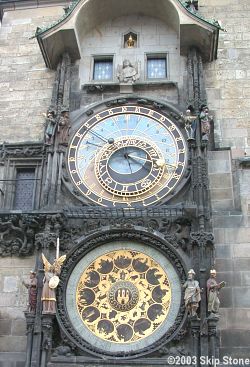
In Prague’s Old Town Square is a clock that has held the public’s fascination since it was built in 1410 by clockmaker Mikulas of Kadan, with an astronomer and professor of mathematics named Jan Sindel. Years and centuries in the making, work continued in fits and starts, with gaps of a hundred years or more until the clock as we know it now was finished in 1866.

Sadly, the whole tower and clock were severely damaged during the Nazi occupation and ensuing uprising in Prague of 1945. The entire building was burnt to the ground, including all of the city’s archives, by the Nazi’s.

Continue reading

Prague Castle


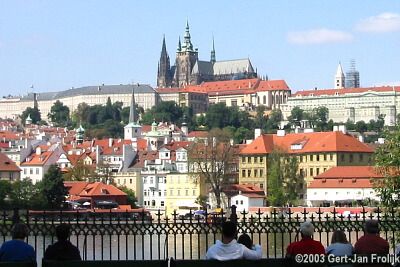
Prague Castle overlooks the Vltava River and the city.

No trip to Prague is complete without a visit the Castle. Prague Castle has been integral to the history of the city, Bohemia, and the Czech Republic for over one thousand years. Founded in the 9th century, it covers 45 hectares (135 acres) with a range of architectural styles from the last millennium.

Continue reading

The History of Wine in the Czech Republic

Recently there was a successful exhibition for Czech wines at the London International Wine & Spirits Fair in May, 2003. In the exhibition booth were the Czech wine producers Víno Marcinčák, Tanzberg, Kolby and Mikros-vín showing off their best selections. The exhibition was visited by more then 15,000 wine specialists, importers, producers, agents, distributors, journalists and wine lovers. Exhibition visitors who tasted the Czech wines agreed on its quality and character. Those prognosticators in the know are saying Czech wines will be found more and more on shelves in the West in the future, as the Czech Republic is set to join the EU in 2004. Continue reading

Charles Bridge

Charles Bridge spans the Vltava River linking Prague Castle with the center of the city. It’s 516 meters long and 10 meters wide and was built in the 1400s, replacing a stone bridge built in 1170, that was destroyed by floods in 1342.

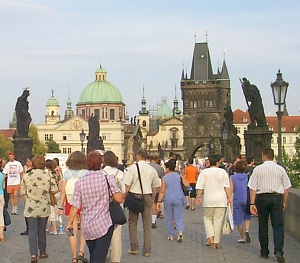
The bridge, a pedestrian link between two other tourists sites, Prague castle and Old Town, is a major tourist attraction itself. Evenly spaced along the bridge are 30 sculptural tableaux, most of them dark with age with various religious motifs. The bridge is so popular, artists and craftsmen arrayed along its length vie for tourist dollars. Thieves and pickpockets likewise ply their trade here, so beware.

But the main attraction of the bridge are the excellent views of the city, the Castle, and the riverscape. You can also get great views if you climb up the Old Town Bridge Tower (in photo on right).

Absinthe or the Green Fairy in Prague

Click to Buy this Poster
Buy this at AllPosters.com

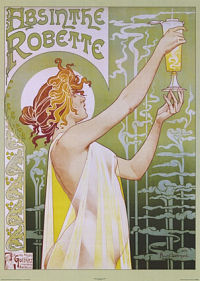
Absinthe, a green-colored bittersweet liqueur, is known as La Fee Verte or The Green Fairy.

In ancient times, Hippocrates recommended absinthe for jaundice and rheumatism. The first modern usage of Wormwood extract, according to lore, was as an elixir for flatulence in the Middle Ages. Later on (1792 to be precise), Dr. Pierre Ordinaire became the first to extoll the virtues of a commercial brand called Absinthe Suisse. It was in 1797 that Henri-Louis Pernod opened the first of his distilleries, happily enough, producing Absinthe in Switzerland and in France. The Czechs have been making high-quality Absinthe for centuries.

During the 1840’s the French Foriegn Legion was spurred on to combat with liberal doses of Absinthe during the Algerian campaigns, perhaps using it to combat the malaria as well. Absinthe became hugely popular in France about this time. In 1859 Manet painted the “Absinthe Drinker,” and he met Baudelaire, presumably over a glass of Absinthe. In 1876 Degas painted his famous “Absinthe.” In 1878 over 7 million liters of the stuff were imported into the puritanical United States!!! Our friend Vincent Van Gogh became one of Absinthe’s first casualties, when he cut off part of his ear, after drinking way too much of the stuff with his friend Paul Gaugin. You can not blame the Absinthe entirely, as Van Gogh was also known to eat his oil paints and drink turpentine, and was known to be psychotic and self-destructive.

Continue reading

Tourists Beware! – Warnings about Prague

Prague is a great place to visit, and a very safe city but a few warnings are in order.

Thieves and Pickpockets: There are many who make their living from unaware tourists. Don’t become their next victim. The busiest places for theives are the Old Town square, Charles Bridge and Prague Castle. Leave your passport and valuables in your hotel safe, and only carry what money you need for the day. Keep your camera and carry bag out of sight and out of reach of strangers when sitting down in a cafe.

Continue reading

Bargains in Prague

Prague is a very inexpensive destination when compared with other capital cities in Europe. Given the culture, sophistication and diversity of Prague, it’s often compared to Paris, yet a trip here will cost far less than a trip to the city of lights.

Beer: Some of the bargains you can expect to find in Prague include the ubiquitous beer. Czechs are quite fond of their brews and gulp down more per capita than any other country in the world! Not only is their beer so good, but it usually costs around one euro for a pint of high octane (10-12% alcohol). No Czech meal is complete without a couple of rounds of their light or dark brews. You can order wine instead, but be prepared to pay double what you’re used to for that glass or bottle of bourdeaux or any imported wine for that matter. Even Czech wine demands a premium price, similar to the imports. Likewise distilled spirits and mixed drinks are way overpriced compared to the excellent deal on beer. So now you know why they quaf so much of the foamy stuff!

Continue reading

Money Exchange

Since Prague is still not part of the EU, you must change your currency at some point. By far the best deal is using an ATM machine. There are two at the airport, not far from the information desk (who can point it out to you). When I went to use one, there was a uniformed armed guard carrying an automatic weapon who I had to shoo away (very carefully!). I recommend you take out a minimum of 1000 crowns (35 euros), but not more than 3000 (100 euros) at a time. If you plan to pay for hotel and meals with credit cards, that should be plenty of cash to play with for a couple of days. You’ll spend less in Prague than you’d expect to spend elsewhere. There are ATMs in town at most bank branches. If you can’t use an ATM for some reason, banks offer the second best exchange rate for cash or traveler’s checks. Of course when they’re closed you won’t have that option.

You can also change money at the many currency exchange windows in town, but they will, without a doubt, give you much less by adding commissions and poor exchange rates. Don’t believe it when they say no commission. That is only if you are trading in Czech crowns for other currencies. You could easily pay 10% or more for a small transaction.

You may also be approached on the street by unscrupulous people who want to change money for you. Don’t do it, or you’ll surely be ripped off! They often try to sell you old notes that aren’t accepted anymore. You’ve been warned!

Once the Czech Republic enters the EU, Euros will rule the day in Prague. But like other countries who went the Euro route, you can expect prices to jump big time when they convert their crowns to Euros. So enjoy the Czech bargains while they last!

Getting Around Prague

Central Prague is very compact and walkable. If your hotel is in the Old Town, or almost anywhere in Prague 1, you can probably walk wherever you want to go. If you need transportation, Prague offers a multitude of options.

Metro: Prague’s metro is fast and reliable. There are several metro lines and all come thru the center of the city, with the main stops at Staremeska (Old Town) and Mustek (Wenceslas Square). It costs only 12 crowns per trip (about 40 Eurocents). There are discount cards for 3 or more days, but you are unlikely to need public transport that much to realize any savings.

Continue reading

How to get to Prague

By Air: Prague is not yet part of the European Union, so there are not as many connections to the city as most Western European capitals enjoy. But you still have a wide range of choices. The best deals on flying to Prague are through the UK with direct flights from London, Manchester and other UK cities. See EasyJet, Czech Airlines and others for special deals that can cost as little as 100 Euros round trip including taxes.

From other destinations, there are often deals on Czech Airlines, but they change all the time, so you must check their site often for the deals that match your itinerary. Expect to pay around 150 Euros for a discounted flight from Paris, Brussels or Amsterdam, which is about half the normal price. Czech Airlines also has deals from the US to Prague, often with a stopover.

Continue reading