Cannabis Smoking Tips

1. There are many reasons to smoke hashish and marijuana, such as to have a good time or to release your creative energies or for meditation. But don’t expect a joint to solve any problems for you.

2. If you smoke hashish or marijuana everyday, try to skip a couple of days now and then. It’s not only healthier to take a break, but it lowers your tolerance so you can again get high on just a few hits.

3. Smoking hashish or marijuana affects your ability to concentrate, so don’t smoke them at school, at work or when you are driving a car.

Continue reading

Get Stoned in Amsterdam!

So you’ve heard that the Dutch are tolerant towards the recreational use of soft drugs. Now you want to find out more about the Dutch Coffeeshop Scene. Well you can take a look at our Coffeeshop Reviews and find that cool place with the right combination of music, ambiance and of course great smoke. But you might also want to read our Cannabis Smoking Tipswhich warn you about the effects and offer suggestions should you do too much.

Continue reading

Pig Out in Amsterdam!


Indonesian Ricetafel

Search For Restaurants by Type
American Chinese Dutch French Greek Indian Indonesian Italian Japanese Malaysian Mexican Moroccan Spanish Thai Turkish Vegetarian

So you’ve got the munchies and need to find relief. Luckily, you’re in Amsterdam where a whole world of tempting delights await to satisfy your hunger for something different.

If you’re looking to eat out, your quest should start with our story about Amsterdam’s Restaurant Scene. It’ll give you an overview of the types of food available. If you’re wondering where to find restaurants, our ever expanding Restaurant Reviewswill point you in the right direction for International cuisine. We’re pretty picky so you shouldn’t be disappointed by our recommendations.

For less formal fare, consider Amsterdam’s Cafes which often have very tasty food and stay open later! If you want a quick, inexpensive bite to fill up your tank, Fast Foodcan be a good option.

If you want to fix your own meal or just pick up some cheese and bread we recommend visiting one of the outdoor markets like the Dutch Specialties to whet your appetite.

Changing Money

There are many ways and places to change money in Amsterdam. Here’s some tips to get the most from your foreign currency.

The best exchange rate is going to come via your ATM card. You’ll probably be charged a couple of dollars (or whatever your equivalent) by YOUR bank in your country for the transaction. Usually you’re limited to about 300 Euros per day (you can ask your bank to increase your ATM limit before you go or even while you’re here!). But the good news is that is the only charge (the Dutch banks don’t add a charge) and you will get the best exchange rate (although they may now be giving you slightly less than before). Getting money this way cost you less than one percent.

Another way to get this top exchange rate is to use credit cards for your purchases which will be calculated at the market rate. With credit cards, you also have less cash to carry and possibly lose. This used to cost you ZERO in terms of exchange fees, but they may be changing this and giving you a slightly lower rate now.

The next best exchange rate is from traveler’s checks, and if you have American Express, you can get a good rate at their offices or any bank or currency exchange. This rate is higher (for some reason) than real money.

If you have real currency to exchange you should be very careful because the rate can vary several percent depending upon where you go. Banks are not the best because they’ll charge you a commission of about 2 1/2 percent in addition to a flat fee (like 3 Euros or so). This can add up to a lot if you have a lot to change. But of course they calculate this based upon the official rate of exchange. But let’s say you change $100, you’d pay $2.50 plus 3 Euros to the bank for the transaction, which would work out to about 5%!

Many money changers work the same way, charging you two fees for one transaction. They also use some deception to make you think you’re getting a good deal. But their rates are never anywhere near the “official rate”, so you’re getting a lousy deal all around.

Thus far we have found only one change place we can recommend, and that is Lorentz change. They charge no commision or fees, so you get exactly the rate posted, which is usually a few cents below the “official rate”. That’s it. Sure makes it easy to figure out, AND it happens to be the best deal in town, just as their signs claim. The second best place is probably Pott Change. Avoid the Thomas Cook as these seem to be the worst and surprisingly the busiest!

Notice: As of Jan. 28, 2002 the Guilder is no longer legal tender in Holland! The conversion rate for Guilders to Euros is 2.203 guilders per Euro.

For current exchange rates check out the Universal Currency Converter.

The Colonies

The Dutch were great explorers and navigators and were first to visit and establish colonies in places like Indonesia (the Dutch East Indies), Suriname, Caribbean islands like St. Martaan (half-french), Curacao, Aruba and Bonaire, New Amsterdam (New York City, and part of NY State). Like most colonialists of the time, the Dutch established colonies around the world to buy and sell raw materials, spices, even slaves.

This rape of natural resources and the trade in human cargo were typical of the time, and led to enomous profits for the Dutch. They also specialized in some of the more addictive substances like cocoa, tobacco, and opium. They wrapped their cargo in hemp fibers to keep it dry on the long ocean voyages. The Dutch word “droog” means dry and supposedly this is the origin of the English word “drug”. In fact it is the Dutch who taught the Taiwanese Chinese to smoke opium with tobacco, which they later decided to smoke straight.

However, unlike most imperialists, the Dutch didn’t try to impose their morality (religion) or social structure upon those peoples they traded with. Their influence over countries like Indonesia and the American colonies were limited.

Few people realize that the passengers who came to America on the Mayflower departed from Leiden, Holland. They were a group who originally moved from England to the Netherlands to enjoy more religious freedom. Perhaps they were a bit too puritanical for the English, and although the Dutch accepted them, they felt the Dutch were too liberal.

When they made out for the new world, their ship floundered and they chartered a new ship, the Mayflower in England to make the famous sea journey and establish their new colony in Plymouth.
The Golden Age

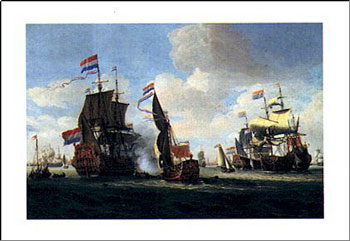
Buy this at AllPosters.com

Once upon a time, the Dutch were the world’s greatest seafarers and merchants. It was a time of great wealth, far flung colonies, huge trading ships and a powerful merchant class. During this period, Amsterdam was the center of commerce, finance, banking and guilds. Many fortunes were made importing the exotic resources of the new world and Asia. With colonies in Indonesia, the Caribbean, both North and South America, Dutch ships transported such expensive products as cocoa, cinnamon, nutmeg, tobacco, pepper, silk and slaves around the world. This wealth is still reflected in the beautiful houses that line the many canals in Amsterdam.

World War II

The Dutch were victims of the Nazi regime during WWII as was most of Europe. The Dutch did not (and still don’t) have much of an army to resist the onslaught of Hitler’s military machine. Hitler was very succinct in dealing with the Dutch. He didn’t want to waste his military muscle on the Dutch (he was saving that for elsewhere) so he demanded their surrender. When the Dutch refused, his bombers reduced the port city of Rotterdam to ashes. He again asked the Dutch to surrender. This time he warned them that Amsterdam would be next. The Dutch surrendered. But they didn’t exactly give in to the Nazis.

Yes there were some collaborators, after all the Dutch viewed Germany as their ancestoral home (unbelievably, their national anthem still makes reference to their German heritage). But many fought back and others hid those being persecuted by the Nazis. Anne Frank was just one of thousands sheltered by the Dutch at great peril. Hundreds of thousands of Dutch citizens (jews and others) were exterminated in German run concentration camps. Another 30,000 are estimated to have died of malnutrition in Holland because the Germans stole all the Dutch produce to feed their army. Tens of thousands more Dutch men were taken to Germany to work in factories for the war machine.

Although the Queen fled Holland to England (taking her vast fortune with her), most Dutch were loyal throughout the war, and many fought the Germans anyway they could. As a result the Dutch can still be seen harrassing Germans whenever possible by giving them wrong directions, pretending not to understand German, or just ignoring them.

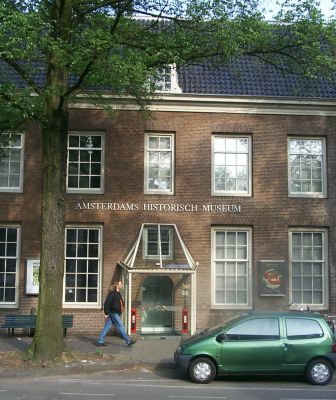
The Amsterdam Historisch Museum

Once a convent then an orphanage, this musuem highlights the city’s development. If you’re into history there are some interesting paintings and art works. The focus is on the Golden Age of Amsterdam. A recent special exhibition covered the history of women in the home. This musuem is perhaps one of the least popular, so you won’t have to wait in line.

Address: Nieuwezijds Voorburgwal 359
1012 RM Amsterdam
Phone: 020-523-1822

Anne Frank House

Visit here for an eerie sensation of what it was like for the Frank Family to hide in an attic during World War II. The original furnishings were destroyed by the Nazis, but the place is haunted by the ghosts of Anne and her family. Excellent, but small display of historical information. If you haven’t read the “Diary of Anne Frank,” get a copy here, available in many languages.

Cannabis College

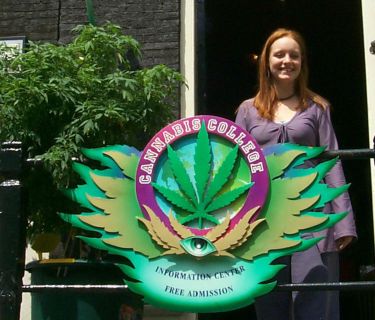
The Cannabis College, on the Oudezijdes Achterburghwal, in Amsterdam’s Red Light District, is a clearing house and archive of accurate cannabis related information. Focusing on the thousands of uses of cannabis (besides recreation), the volunteers here are extremely knowledgeable about all aspects of this amazing plant. There are displays with hundreds of samples of cannabis related products including clothes, cosmetics, food, and much more. There are two electronically controlled vaporizers for you to try this healthier method of cannabis ingestion.

Downstairs there’s a working indoor marijuana garden, complete with growers on hand to answer your growing related questions. There is a €2.50 donation to view the garden, otherwise the rest of the College is free to browse. We encourage all who visit to donate something to this worthy cause.