Thanks to the tolerant attitude of the Dutch, soft drugs (marijuana and hashish) are everywhere and can be purchased at any one of over 400 coffeeshops. See our Dutch Coffeeshop Scene for more info. In addition all over town are smart shops that sell magic mushrooms, and herbal ecstacy type products. If you’re looking for these sorts of soft drugs we recommend a stroll down the Damstraat into the Red Light District. What ever you do, don’t buy anything on the street. Not only will you get ripped off, you might get sick! There is no need to buy soft drugs on the street! And lastly, don’t bring any drugs back home, it ain’t worth the risk!
Kinky Stuff
You’ll find everything you can think of in Amsterdam. Besides all the porno shops, most of which sell some clothing and accessories, there are specialized fetish shops for those who love leather, spikes, restraints and whatever else you fancy. If this is your thing they also have clubs and special event nights around Amsterdam where you can dress for the scene.
Visit the Real Kinky Forum!
Jewelry and Ceramics
Amsterdam tourist shops usually have a good selection of ceramics with little colorful canal houses being very popular. Delftware is of course more expensive. Be sure to get a certificate of authenticity to guarantee its Delftware. Diamonds are still cut in Amsterdam as they have been for centuries. Don’t expect any bargains, but you should be able to find a good selection if you visit one of the larger places like Coster Diamonds (free tour), founded in 1840, across from the Rijksmuseum.
Antiques & Art

The Jordaan has a nice collection of small antique shops, each specializing in a period or region. It’s a pleasant area to stroll (little traffic), and windowshop. There are also art galleries in the Jordaan, around the Concertgebouw and on the Rokin. If you have more money you might want to attend an auction at Sotheby’s or Christie’s auction houses.
The Melkweg has an eclectic photo gallery worth checking out!
Rembrandt van Rijn (1606-1669)
The Night Watch, 1642 |
The Syndics of the Clothmaker’s Guild (The Staalmeesters) 1662 |
Rembrandt’s Eyes by Simon Schama |
Perhaps the greatest of the Dutch Masters, Rembrandt Harmenszoon van Rijn is justly remembered for his innovative work and for his marketing savvy (a true Dutchman). He was a master of etching and chiaroscuro (light and shadow). Unlike most artists, Rembrandt was very successful during his lifetime, having a bevy of patrons amongst the wealthy burghers of Amsterdam. His house is a popular tourist attraction. His famous huge painting, “The Night Watch”, hangs in the Rijksmuseum in Amsterdam. |
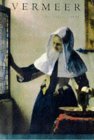
Johannes Vermeer
The Milkmaid, 1658-60 |
View of Delft, c. 1660-61 |
Girl with a Pearl Earring, 1665 |
| Not nearly as prolific as Rembrandt, Vermeer’s 35 known paintings are scattered around the world. His relatively small paintings depict everyday people going about their business in indoor settings. | Vermeer : The Complete Works by Arthur K., Jr Wheelock |
Piet Mondrian (1872-1944)

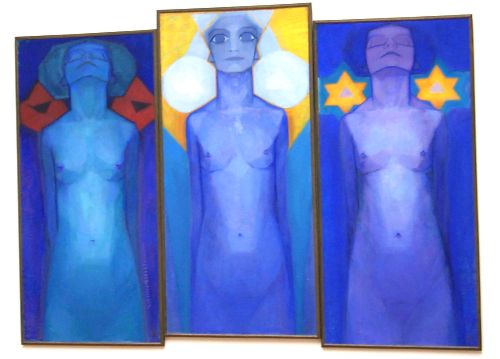
This pioneer and icon of the abstract art world is noted for his geometric paintings of lines and boxes using mostly primary colors. These simplistic cubist works, some consisting of as little as three horizontal or vertical black lines on a white background, influenced many abstractionists. My best friends in Holland have done their entire apartment Mondrian style with the bright colors everywhere. Mondrian cabinets, refrigerator, chairs, desk, coffee mugs, etc., etc. Sorta reminds me of a preschool. Unlike Bosch, Mondrian is highly regarded in Holland, perhaps reflecting the Dutch penchant for orderliness, cleanliness, and simplicity. Mondrian’s last, unfinished painting,
Hieronymous Bosch (1450-1516)
| The Garden of Earthly Delights , Hell, 1504 (right wing detail) |
The Garden of Earthly Delights , Hell, 1504 (right wing detail) |
The Garden of Earthly Delights, 1504 |
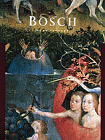
| For some strange reason (which I’ll try to fathom), Hieronymous Bosch is not so highly regarded in his homeland. In fact a visit to the Rijksmuseum in search of one single Bosch painting is an exercise in futility. I recently visited the museum’s excellent website, and alas, he is left off the list of hundreds of Dutch artists! This flemish painter whose magnificient yet eeire landscapes filled with bizarre creatures, horrific demons and blasphemies (Garden of Earthly Delights) influenced many artists including the surrealists, is almost a non-entity in Holland. My guess is his religious themed works didn’t play too well during the golden age, when the Dutch were pursuing pleasure, not piousness. Bosch’s hellish message of paying grotesquely for sins in one’s lifetime was probably as much a turnoff to the existential Dutch (then and now) as the Spanish Inquisition was during it’s heyday in Holland.
Perhaps another reason is that much of his work has been spirited off to Spain and France, hanging in the Louvre and Prado museums. It seems the Catholic countries can better appreciate the evils of sin and the price to be paid in hell. Update: I recently got to see the excellent Bosch exhibition at the Museum Boijmans Van Beuningen, in Rotterdam and learned that his paintings were so prized that they were taken as war booty and thus were spirited out of Holland and ended up in the museums above and others around the world. The exhibit was marvelous but crowded, which contrary to my earlier statement shows that the Dutch DO appreciate Bosch after all! |
Hieronymus Bosch (Masters of Art) by Carl Linfert |
Zandvoort

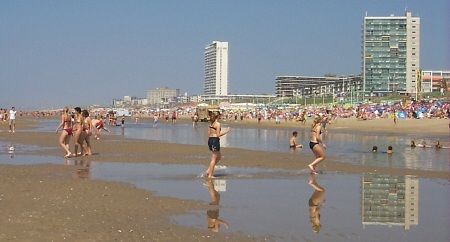
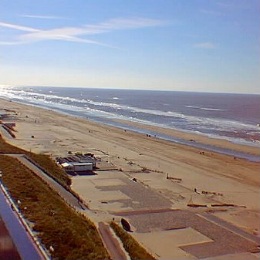
Only a half hour from Amsterdam by train, the North Sea resort of Zandvoort can be packed with what seems like a million people on nice summer days (or almost empty on a winter one – see photo below). The Dutch are so sun-starved, that when it shines, the entire country seems to take the day off and goes to the beach.
The town itself is geared towards the tourists, with lots of guesthouses and hotels, restaurants and cafes, and shopping that is even open on Sundays. A beautiful promenade with benches overlooking the beach extends for several kilometers north and south of town.
During summer months the strand is lined with temporary structures serving as cafes, bars and restaurants and they can be very busy. The beach is long and wide, stretching for endless miles, and you can get away from the crowds if you are willing to walk. The scenery can be quite nice, as the Dutch women don’t hesitate to go topless in public at the beach. (A mixed blessing to be sure…)
A 45 minute stroll north along the beach from Zandvoort is Bloemendaal, a more relaxed place to hang out or a huge party scene, your choice. There is also a posted nudist beach about 3K south of town, a nice walk.
Utrecht
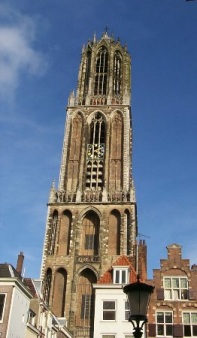
A 45 minute train ride from Amsterdam, Utrecht is known for the amazingly tall spire on the cathedral there, as well as it’s university. The train station is also a huge indoor mall, which is a new concept for the Dutch. Malls in the States are dying, but just getting popular in Europe.
The Centrum of Utrecht is just a few blocks from the train station, and a lovely canal winds its way through town. The canal is interestingly constructed with two levels alongside the banks. The lower level has iron doors lining a narrow walkway alongside the canal. The barrel-vaulted low-ceilinged rooms are filled with small shops, restaurants, cafes and store rooms. Above is the street level with buildings crammed into every spare inch of canal frontage.
Typically Dutch, narrow houses and shops line every street. There are a number of interesting restaurants situated at the water level. Every year in June, Utrecht hosts a Blues Festival with bands playing outdoor venues around th
e town – for free!