

Pan Amb Tomaquet – Catalunyan Bread

Pan Amb Tomaquet is a tomato crustini-type thing from Catalunya, in the north east of Spain. The words translate literally as bread with tomatoes.

The preparation takes a while to figure out, just by watching people at the other tables, but it is quite fun and tasty to have bread this way… Of course if you speak a little Catalan the waiter might give you a lesson.

Take slices of toasted bread, peel a clove of garlic and rub the bread with the clove. Slice a tomato in half, rub the juice on the bread, then sprinkle with olive oil and salt.

This is one of those things that makes you go mmmmmmmmmm… And it occupies the time while waiting for that fabulous meal.
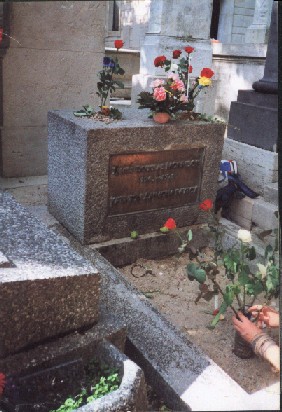

Jim Morrison’s Grave


Apparently Jim’s grave has been cleaned up now!

Jim Morrison’s grave is located in the Pere-Lachaise Cemetery in the east of Paris. The closest metro stop being Pere-Lachaise/Phillippe Auguste conveniently enough, it is east of the Bastille. Not recommended as a place to hang out and drop acid to commune with Morrison’s spirit, as the line of Gendarmes keeping vigil are never amused. Graffiti abounds, candle wax has dripped everywhere and it’s a really sad sight.

Manet & Velazquez:. The Spanish Manner in the Nineteenth Century

Now showing until January 5th, 2003 at the Musée d’Orsay

If you love art for the good old-fashioned pleasure of seeing paint beautifully applied to a canvas, then this is the show for you. The curatorial goal is to demonstrate the influence of 17thc Spanish artists—Velazquez, Goya and Zurburan—on 19thc French artists like Manet, Delacroix, and Courbet. But in order to make that convincing case, the curators also happened to assemble an extraordinarily gorgeous group of paintings. Half of these hail from what is referred to as the “Golden Age” of Spanish painting, and the other half from a time when the French avant-garde never looked better.
Some visitors to “Spanish Manner” may find that Baroque manner a bit heavy on the religion. But even a modern agnostic has to be moved by the Spanish masters’ sublime use of shadows and light. Manet certainly was; he considered Velazquez in particular to be “the painter of painters.” As you can see for yourself in the major collection of Manets assembled here, the Frenchman studied the subtleties of the Spaniard’s spare, dramatic effects quite closely.

Continue reading

Nieuwmarkt

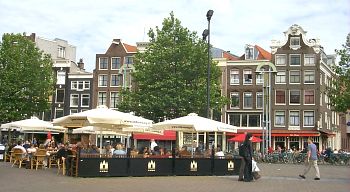
Located at the edge of Amsterdam’s Red Light District, and part of the ever expanding Chinatown, the Nieuwmarkt, is a picturesque open space with lots of bars, restaurants and coffeeshops in the area.

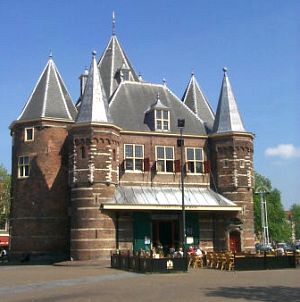
Dominating the Nieuwmarkt is the Waag, once part of the ancient wall (circa 1488) around Amsterdam, it now houses a trendy organic restaurant.

Continue reading

Museumplein

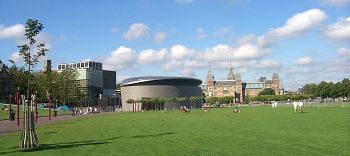
Amsterdam’s Museumplein has been completely renovated, and is now one of the most popular parks in the city. A huge expanse of green grass extends from the Rijksmuseum on one end to the Concertgebouw on the other. Also surrounding the Museumplein are the Stedelijk Museum, the Van Gogh Museum, an underground Albert Hein supermarket, as well as embassies including the American Consulate cattycorner from the Concertgebouw.

Continue reading

Dutch TV

In the past few years, there have been remarkable changes taking place in both the range of options and the programming quality available in Holland. The introduction of digital cable and satellite dishes have expanded the number of channels way beyond what was broadcast over airwaves, or on the analog cable systems of just a few years ago.

Now you can see TV from all over the EU and Asia, Africa and the US. With digital cable and satellite you can also order movies or listen to digital audio from dozens of genres. You can even send and receive email on certain systems.

I must warn those moving to Europe that their existing TVs and VCRs from other countries might not work in Holland. The Dutch broadcast using the PAL B/G format, and any NTSC equipment won’t work. Unless you have multiple formats available on your equipment you’ll be out of luck for viewing Dutch TV, or videos. If you purchase equipment in Holland it might not play your NTSC videos or work back in your home country.

Continue reading

Dutch Telephones

The Dutch telephone system has undergone a complete revolution thanks to the developments of the past few years. Once upon a time the system was under the complete control of KPN, the royal Dutch phone company. Today, several years after the monopoly was broken, KPN is nearly bankrupt, failing to compete with mobile phones, international and other Dutch phone service providers.

So what options are now available for making calls in Holland? First, the once ubiquitous phone booths are almost extinct. It used to be every public business like pubs, restaurants even shops had a public phone. But thanks again to the widespread use of mobile phones, few locals need to use a pay phone anymore. So finding them is next to impossible. In fact, not long ago I was in the Jordaan, without my cellphone, and needed to make a call. I stopped in half a dozen public places, some of which still had a phone, but not one still worked.

Continue reading

Amsterdam Movie Theaters

In Amsterdam going to a movie theater can be an interesting experience. I remember one of my first visits to the Tuschinski theater, I was stuck in a small, hard seat in the balcony with my knees stuck up against the chair in front. I needed a shoe horn to get in it, and a crowbar to get out. In addition the cigarette smoke was choking me, and the interminable “pauze” or break in the middle of every movie was enough to make you wait for the video release.

At the time I thought something was seriously wrong with movie going in Amsterdam. Other theaters suffered similar problems, too, especially the smoke. Well things have been changing, and many movies are now shown without the “pauze”, and some theaters have banned smoking too.

Continue reading

Avebury Stone Circle Panoramic Tour

Avebury Stone Circle
Panoramic Tour.

Aveburywas built during the Neolithic period and is the largest complex of Stone Circles & Avenues on earth.

Avebury was ‘Rediscovered’ by John Aubrey in 1648. He published an account of his frequent visits in his book ‘Monumenta Britannica- Templa Druidum.’

In the 1720’s the antiquarian William Stukeley mapped all the surviving Avebury stones and left a huge record of his visits in words and drawings. He published his findings in his book ‘Abury, A Temple of the British Druids‘.

The site was restored in the 1920’s & 30’s by Alexander Keiller who’s posthumously published book ‘Windmill Hill & Avebury Excavations 1925 – 1939‘ is considered the most complete account of the complex..

Avebury is now a World Heritage Site. It is currently badly managed by the National Trust…

We hope you enjoy your virtual visit to Avebury.