Writer’s Workshops

Writers Workshops (in English) are being held with great success at the ABC Treehouse here in Amsterdam.

Currently there are three critique groups for writing works-in-progress (novels, stories, essays, articles, etc.). These groups meet every two weeks on Wednesdays or Thursdays. The fee for attending is only 7 euros per session. The Treehouse asks all interested writers to register in advance for membership in this exclusive writer’s club, and regular attendance is expected.

The poetry critique group meets every three weeks on Tuesdays. The fee is also just 7 per session.

The writing exercise class meets every other Wednesday and is open to everone. Meeting times are from 7 pm until 10 pm and the participation fee is 10 euros per session.

Please bring your own pens and paper to these meetings.

We post the schedule for writer’s workshops and other Treehouse events here on the Hip Guide to Amsterdam’s event calendar, and for more specific information you can visit the American Book Center on the Kalverstraat for lots more, and tons of books. Alternatively, call Jonette Stabbert at (020) 683 8862.

Omelette Francais

The traditional French omelette is to be admired. Simple, filling, and tasty. Quick and easy to make by following the instructions, make sure you assemble ALL the ingredients, before you start cooking. Having the ingredients at room temperature makes for a fluffier finished product.

You can’t make a great omelette by rushing things out of the frig and dumping them into any old frying pan, you have to put it all together with a bit of care and respect for the food itself.

Of course the pan itself is an issue. A good omelette pan will allow you to slide the creation out and fold it at the same time, a pan with high sides requires a spatula. And a properly seasoned omelette pan is often any chef’s most prized possession.

Continue reading

Champignon Poulet au Vin Blanc

Champigon Poulet au Vin Blanc

From the Alsace you can count on good wines, and fine food. My favourite of the moment is an easy one-dish meal that offers a homey complexity of flavours. The following recipe will serve four, and is nice to have with with crusty French bread and a bottle of crisply chilled white wine. Just remember that with all things French, freshness is the key to success.

Continue reading

Zeedijk

The Zeedijk has been renovated and is now a wonderful pedestrian mall that wanders through the oldest part of Amsterdam. Once the shipping center of Amsterdam, it’s now home to Amsterdam’s Chinatown with restaurants, pubs, small shops, and many residences hidden away on upper floors.

Most of the buildings in this area have recently been restored as well, and the facades are as beautiful as ever. This is one of the best areas in town for Asian food, check out our restaurant guide for more info.

TIP!: A good tour would be to start at the Nieuwmarkt, proceed down the Zeedijk, return back via the Warmeosstraat, see the Oude Kerk, and cut across the Red Light District. Metro: Centraal Station or Nieuwmarkt

Sherry from Jerez

Sherry

Sherry is from Jerez in southern Spain. This fine wine is often drunk as an aperitif, or traditionally in Andalucia, chilled with a variety of tapas.

Sherry is fermented from the Palomino and and Pedro Ximénez grapes. The Palomino grape makes a dry, delicate sherry and the Pedro Ximénez grape makes a fuller, sweeter type of sherry.

The grapes are picked usually during the first three weeks in September. The Palomino grapes are rushed to the presses to ensure freshness.

Drying is required for the Pedro Ximénez grapes, as they are too juicy when picked. They are laid on mats to partially dry in the sun, thus concentrating the sugars.

Pressing the grapes is usually done at night to avoid the heat of a typical Andalusian day.

The grapes are fermented in vats, and Flor, a yeast, forms on the surface of the wine in the vat. They say this prevents oxidization and adds flavor. If flor develops naturally, the wine is a determined to be fino.

The next step in the process is fortification. The addition of pure grape alcohol raises the level of spirit from a natural 11 percent to 18 percent for oloroso sherry, and 15.5 percent for finos.

Over the ages Jerez sherry producers developed a technique known as the solera system, which assures that the qualities of a sherry remain constant through the entire batch. The wine from the youngest solera (or top row of barrels in the cave) is mixed with the older wine in the barrels below and as a result takes on a smoothly blended character. Eventually the wine from the oldest solera in the bottom row is bottled as sherry.

In Jerez look for these brands of sherry: Barbadillo (Solear), Blázquez (Carta Blanca), Caballero (Puerto), Garvey (San Patricio), González Byass (Alfonso, Tío Pepe), Hidalgo (La Gitana, Napoleón), Lustau, Osborne (Quinta), Pedro Domecq (La Ina), Sandeman.

By Martin Trip, Editor of the Hip Guides.
Wines of Spain

Spain has been producing a multitude of quality wines for centuries in the fine air and sunshine of the Spanish countryside. The climate is superb for grape growing in most regions of Spain, and we offer a description of the wines from three regions of Spain.

Northern Spain

In the north, immigrants from the Bordeaux region populate the area of Rioja, and make some very fine wines indeed. Famous labels from Rioja include Faustino, Marqués de Cáceres, and La Rioja Alta.

Red, rose and white wines are produced in the north-central region of Navarra. Names from this area include Bodega de Sarría, Guelbenzu, Magaña, Ochoa, and Príncipe de Viana.

Further west the area of Galicia is noted for the full-bodied white wines they produce. A sure bet would be something from the region of Ribeiro in Galicia.

So, we suggest Rioja and Navarra for reds, and Galicia for whites.

Also in the north of Spain is the Basque country, where there is a small area known as Txacoli de Guetaria, which makes an unusual and spicily tart wine.

The major grape varieties grown in northern Spain are Tempranillo, Garnacha, Graciano and Mazuelo. In Navarra they also grow Cabernet Sauvignon grapes and blend them with Tempranillo for an excellent vintage. Garnacha grapes are made into rosados (rosés). Galicia grows Albariño, Loureira and Treixadura grapes for their wines..

Continue reading

Tapas

Traditionally TAPAS were served with your drink, on a tiny plate as a lid, or cover, reputedly to keep the flies out of your drink, but also as a tasty morsel to keep you happy in the bar, and drinking more and more. Sort of like salty chips in the US, but way classier. The word TAPA means lid or cover.

There is an amazing variety of tapas and tapas bars abound throughout Spain, but are especially interesting in the old quarters of the ancient cities. Here a popular pastime is tapas bar-hopping – sampling different delicacies from competing bars, and spending lots of time socializing along the way.

Tapas can be anything from fried fish to meat stews or cold-cuts and cheeses, to fried veggies, mushrooms, and tortillas (in Spain a TORTILLA is an OMELETTE).

Tapas generally come in three sizes, and are not cheap – you can spend more on a meal this way than having a sit-down restaurant dinner. Montados are the original little tapa on a slice of bread; raciones are half-ration dishes; and a porción is a full portion.

Here are a few typical tapas combinations – Chickpeas and Spinach, Clams in Sherry Sauce, Octopus & Paprika, Meatballs in Almond Sauce, Fried Cheese, Quail and Onions, Dried Cod & potatoes or Sole with Raisins & Pine Nuts.

Pan Amb Tomaquet – Catalunyan Bread

Pan Amb Tomaquet is a tomato crustini-type thing from Catalunya, in the north east of Spain. The words translate literally as bread with tomatoes.

The preparation takes a while to figure out, just by watching people at the other tables, but it is quite fun and tasty to have bread this way… Of course if you speak a little Catalan the waiter might give you a lesson.

Take slices of toasted bread, peel a clove of garlic and rub the bread with the clove. Slice a tomato in half, rub the juice on the bread, then sprinkle with olive oil and salt.

This is one of those things that makes you go mmmmmmmmmm… And it occupies the time while waiting for that fabulous meal.

Jim Morrison’s Grave


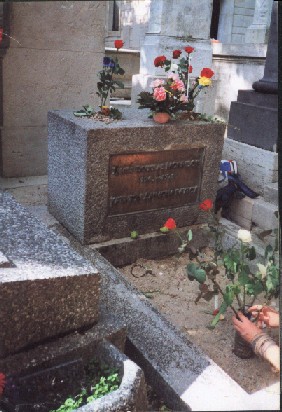
Apparently Jim’s grave has been cleaned up now!

Jim Morrison’s grave is located in the Pere-Lachaise Cemetery in the east of Paris. The closest metro stop being Pere-Lachaise/Phillippe Auguste conveniently enough, it is east of the Bastille. Not recommended as a place to hang out and drop acid to commune with Morrison’s spirit, as the line of Gendarmes keeping vigil are never amused. Graffiti abounds, candle wax has dripped everywhere and it’s a really sad sight.

Manet & Velazquez:. The Spanish Manner in the Nineteenth Century

Now showing until January 5th, 2003 at the Musée d’Orsay

If you love art for the good old-fashioned pleasure of seeing paint beautifully applied to a canvas, then this is the show for you. The curatorial goal is to demonstrate the influence of 17thc Spanish artists—Velazquez, Goya and Zurburan—on 19thc French artists like Manet, Delacroix, and Courbet. But in order to make that convincing case, the curators also happened to assemble an extraordinarily gorgeous group of paintings. Half of these hail from what is referred to as the “Golden Age” of Spanish painting, and the other half from a time when the French avant-garde never looked better.

Some visitors to “Spanish Manner” may find that Baroque manner a bit heavy on the religion. But even a modern agnostic has to be moved by the Spanish masters’ sublime use of shadows and light. Manet certainly was; he considered Velazquez in particular to be “the painter of painters.” As you can see for yourself in the major collection of Manets assembled here, the Frenchman studied the subtleties of the Spaniard’s spare, dramatic effects quite closely.

Continue reading