History of London

The Romans founded London in the year 50 AD, and the city burnt to the ground just ten years later when Queen Boudicca from present-day Norfolk led a major anti-Roman rebellion.


However, the Romans rebuilt, and administered Britain through this capitol city until AD 410. Then the Dark Ages descended on Britain, and London was mainly in ruins for hundreds of years hence. The scattered Roman survivors clung to hordes of old Roman coins lived in hiding until they died from plague or pestilence.

Continue reading

Cornwall is the Best of Britain

And not the inane comedic characters from the BBC show either, this is the real thing.
 
Cornwall is the southwest tip of England facing the Atlantic Ocean, and guarding the English Channel.
Some of the things to see and do here include the Eden Project, castles ranging from Tintagel on the north, windy shore, to St. Michaels Mount near Penzance. Continue reading

The Islands of Fiji

Fiji is an island group in the South Pacific located northeast of New Zealand, near the International Date Line. A long-time British Colony, Fiji has enjoyed independence since 1970. Captain Bligh once found refuge here after the “Mutiny on the Bounty.”


With the most landmass in all of Polynesia, Fiji boasts 333 islands, but only about 100 are actually inhabited. The islands are mainly volcanic, with some smaller islands being made up from coral atolls and reefs. Viti Levu is the biggest island, with an interior highland plateau mostly over 1000 feet in elevation, and villages and towns scattered around its coastline.

Suva is the capitol of Fiji, and the largest city with a population of several hundred thousand. Vanua Levu is the second-largest island, and is mainly residential, filled with native villagers living in a tribal society.

The islands were once covered with lush virgin rainforest, but this has been heavily logged over the years. Almost all the native sandalwood trees are long gone, and mahogany is the next victim of the lumberjacks. You’ll see the logging trucks as you drive around Viti Levu. In the drier areas of the islands, people have been growing sugar cane for decades, and the destruction of the native flora and fauna continues. There are very few pockets of original rainforest left, but there is an active campaign to reforest the island with pine trees.

It is wonderful to see the many thousands of beautiful fern trees of Fiji thriving. They seem to be growing everywhere, and not just being used as the timbers in the traditional Bure huts the Fijians build.

Bats are the only native mammals to the islands, and the mongeese you see were imported from India in a vain attempt to control the snake population on the islands. Otherwise, Fiji is known for the thousands of bird varieties that are to be found here. The best islands for birdwatching are Taveuni, Kadavu and Vanua Levu. Species to look for are Fiji petrels, peregrine falcons, silktail and long-legged warblers, and of course the many parrots of the islands.

Tips for Fiji Travel

Fiji is a wonderful place to go on holiday, with a variety of hotels and resorts willing to put you up, feed you, and entertain you. Bula is the word for welcome, and it drips off everyone’s smile quite readily! Fiji is a welcoming place with a beautiful climate and friendly people.

To get to Fiji you will fly into Nadi International Airport on the west side of Viti Levu, the main island. There is another international airport near Suva, the capital, but it serves fewer flyers, mainly inter-island hopping flights.

Continue reading

Fiji’s Checkered History

An ancient land filled with waterfalls, remote tropical islets, forested big islands, rare tropical plants and birds, Fiji is an exotically wonderful vacation destination. Originally a land of cannibals, Fiji is now known as a former British colony and ex-pat hangout, with an atmosphere of slow colonial decay pervading the islands and its infrastructure. Tempered by the exhilarating rush of tourist dollars, this malaise gives way to hustle and bustle in Suva and Nadi, the big towns of Fiji. Otherwise, you are on remote tropical islands in the midst of the South Pacific. But how did we get here?


Fijian Warriors

According to Dr Roger Green, Professor of Anthropology at Auckland University, in New Zealand, the first settlers arrived some 2,000 years before Christ was born. Comprised of two distinct peoples, one Melanesian, the other Polynesian, these early settlers spent millennia battling each other for control of the islands.
Continue reading

History of Australia

The Police State of Australian History

At the dawn of time Australia was part of one massive continent that covered the earth. This eventually broke up as the oceans formed, and this land was called Gwandanaland. Australia is ancient, flat and remote; and also one of nature’s cruelest places in terms of natural selection, and the history of its inhabitants.

The first people started to appear some 60,000 years BC. The next creature to arrive on the scene of significant impact was the Dingo, which arrived some 3,500 years ago and decimated of most of the original slow-moving marsupials.

Continue reading

Dutch Economy Shrinks

Dutch Econmy Shrinks

According to reports, the economy shrunk in Holland for the first time in 20 years, due to slower exports. Perhaps this is due to the high exchange rates on the euro, or the world economy at large. Unemployment recently rose to 6.6 percent in April 2004 and is still rising.

In spite of this seemingly bad news, the Netherlands ranks eighth in the world as an exporting nation, and the third largest in food exports worldwide. Amazing considering the small size of Holland, with it’s three names for itself.

Whether you call it Dutch, Holland or the Netherlands, this place is still incredibly productive and industrious compared to any other nation on earth.

The highly-educated multilingual country is home to many worldwide banking, insurance and manufacturing companies such as ABN-AMRO, Phillips, and Shell.

Amsterdam’s Schiphol airport is one of the world’s largest transportation hubs, and the port of Rotterdam is on of the biggest transshipment points of global trade.

Very important stuff.

However, there are still some serious drawbacks to doing business in the Netherlands, and old traditions die hard in this country. Holland has the highest rate of temporary workers in the world, and the glass ceiling is firmly in place for women trying to get to the top of any business structure. Women do not exist at the managerial level in the Netherlands, or very rarely. This part-time work mentality leads to masses of people with careers in a virtual loop of always looking for the next job, and no stability. Yet they pride themselves on their flexibility as they flock to the coffeeshops, cafes, bars and restaurants to fuel the service industryu with their hard-earned euros.

~Martin Trip

Mission Beach


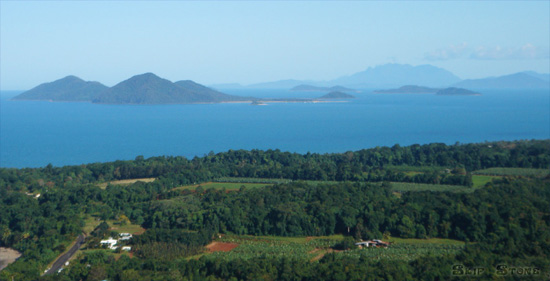
View over Mission Beach, Dunk & Family Islands from Bicton Hill

Mission Beach is a very laid back community in Far North Queensland. Off the main highway, it has avoided the over development that has infected so many beach towns in Australia. Surrounded by lush rainforest, the town is home to 4000 humans and 40 wild cassowaries. You can’t miss all the signs reminding you to slow down for them. They are an endangered species, and with planned further development they will probably soon disappear from Mission Beach and their other remaining habitats in Australia.

Continue reading

Handheld GPS for rent to tourists in Amsterdam

Amsterdam is the first city worldwide where a GPS based handheld navigational device can be rented by tourists. The City Navigator is easy to use and filled with 500 selected points of interest; tourist attractions, restaurants, bars, entertainment, museums, cultural hotspots etc., as well as various interesting pedestrian routes. The City Navigator helps its users to find their way effortlessly through the beautiful Dutch capital with turn-by-turn directions in all European languages. Strolling through town the users can see on the map which special places are in their direct vicinity. The City Navigator is for rent at various hotels. Prices from 16€/day.

Background:
Tourists often get lost. In the historical centre of Amsterdam they virtually stand on every street corner staring at a city map trying to figure out how to get to their next destination. The strength of navigation systems that use the Global Positioning System is that it always displays the exact position on an electronic map and that is where the fun starts.

Using the City Navigator, visitors find their way without the endless discussions and quarrels how to get to there. Since it is programmed for pedestrian use,(it also works great on a bicycle!) it always takes the shortest possible route, usually taking you off the main roads and through the charming picturesque streets of Amsterdam. The location based service always gives information on the restaurants, bars, museums, shops, picturesque places near their current location. Amsterdam is relatively small compared to other capitals like Paris and London. Tourists still often get lost because they have no feeling for the scale of the City.

With the City Navigator visitors can feel free to roam the town without having to worry how to get back to the hotel, and always have all interesting places at hand.

The Citynavigator is the perfect addition for printed media (travel guides, etc.) as one can find any address in greater Amsterdam with one touch of a button.

More info:
www.citynavigators.com

Kuranda


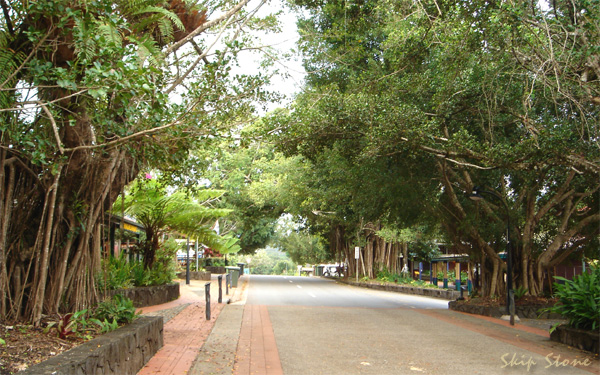
Kuranda’s Main Street

 Kuranda is a little town perched on the edge of the Atherton tablelands, about 40 minutes from Cairns. It lies amidst ancient rainforest alongside the Barron River and attracts tourists who arrive via the Kuranda Steam train up the Barron Gorge or over the hills and river by Skyrail (cable car), or by bus or car.

Continue reading