Classical Music in Prague

The city of Prague is blessed with classical music, at every corner and turn there is a poster announcing this or that concert. Usually with the likes of Mozart, Dvořák or Smetana on the bill, a concert is a great thing to experience in this lovely city.

In terms of venues, besides the impromptu concerts organized in every church, cathedral, concert hall and open square, the city of Prague offers two large established opera houses, with four major orchestras.

During Prague’s annual Spring Festival there is even more to offer than at other times of the year. The Prague Spring International Music Festival is a permanent showcase for outstanding performing artists, symphony orchestras and chamber music ensembles of the world. Since 1952 the festival has opened with Bedřich Smetana´s cycle of symphonic poems Má vlast (My Country), and it closes with the ninth symphony of Ludwig van Beethoven.

Continue reading

Benidorm on the Costa Blanca

The town of Benidorm, located on the Costa Blanca in Spain, is not a sleepy fishing port, with hammocks swaying in the sun by a beach. Well, there may be some hammocks swaying by the beach, but the ‘town’ of Benidorm boasts some of Spain’s tallest hi-rise buildings.

 Located 45 kilometers northeast of Alicante, it’s a convenient and inexpensive place to fly into from just about anywhere in Europe. Benidorm is known for it’s white sand beaches and nightlife, albeit Las Vegas-style.

Continue reading

Calpe’s Penyal de I’fac or Piñon de Ifach

Piñon de Ifach and Calpe’s Port

Located between Valencia to the north, and Alicante to the south, the town of Calpe is dominated by the 332-meter tall “Piñon de Ifach,” or the rock of Ifach. The rock itself juts out into the sea as imposingly as does the Rock of Gibraltar, and is a beautiful protected mountain wilderness area and park with several spectacular hiking trails and excellent rock-climbing.

Continue reading

Villa Rentals in Spain

If you’d like to visit Spain, but don’t want to stay in hotels or apartments, you should consider renting a villa. If you’re going to stay in one place for a week or more, we highly recommend Spanish villas because they provide a more unique experience and can usually save you a lot of money, especially in the off-season. It’s also a good idea if you’re looking to buy property in Spain to rent a villa in the area you’re considering first, to see what it would be like living there.

Most rental villas are located along the beautiful Spanish coast, and usually have stunning seaviews, a swimming pool, lots more room than apartments, and normally can accommodate six or more persons. While there are some older style villas available, more and more villas are relatively new or have been recently remodeled. This means a modern kitchen with a big refrigerator, and sometimes a dishwasher. All villas have a washing machine, but few have dryers as drying your clothes outdoors is one Spanish tradition that’s hard to change.

Continue reading

Royal Castle of Warsaw


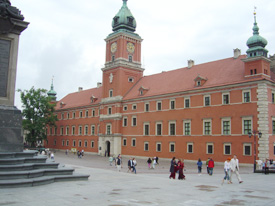
Royal Castle, Warsaw
When arriving in Old Town Warsaw, the most striking building you will see is the Royal Castle. This was the ancient residence of the Mazovian and Polish Kings, and the seat of the Sejm during the Commonwealth.

The Royal Castle was blown up by the Nazis in 1944.

According to the castle’s website, "the plan to rebuild the Castle failed to win approval from the Communist authorities for many years.The decision to reconstruct it finally was made in 1971, rewarding the attempts of the nation’s intellectual elite to recreate this symbol of Polish statehood."

The reconstruction of the Castle was funded privately, not by the government. The interior being furnished with original works of art that had been rescued before the Castle’s destruction.

They also go on to say that "the Castle is a prime monument of national history and culture. Each year hundreds of thousands of visitors enrich their knowledge of history and deepen their aesthetic appreciation within its walls. It provides the setting for cultural events and official state ceremonies, as well as visits by figures from international political life."

Visiting here will give you a glimpse of the royal splendor that existed in the past, in Poland.
Continue reading

The National Museum in Warsaw

Begun in 1916, the National Museum in Warsaw was completely rebuilt and reorganized in 1995. The traditional prewar names of museum units were reintroduced and the Sculpture Collection was renewed. There is a new Collection of East Christian and Byzantine art.

The opening of new permanent galleries, the Gallery of Italian Painting and a reorganized Gallery of Ancient Art, occured in the year 2000. Continue reading

Historical Museum of Warsaw

Located in the Old Town Square in a row of completely resorted old houses, you should visit the Historical Museum in Warsaw. Visiting here is key to understanding why there are so many ghosts wandering around this city.

According to the museum’s website, the traditions of the Historical Museum of Warsaw go back to the period between War World I and War World II. The Old Warsaw Museum came to existence in 1936 and was situated in the Old Town Market Square in the tenement – houses once belonging to the Barycz-ka and Szlichting families. During the World War II the Museum shared the fate of its city and was completely destroyed during insurrection fighting in Warsaw Uprising in 1944.

After Poland’s liberation the Museum of Warsaw was created and estabilished in eleven tenement – houses in the Old Town Market Square and Nowomiejska Street reconstructed according to old plans and drawings. It has preserved the beauty of the Renaissance facades, vaults, staircases and interiors.

In 1946 the Museum didn’t have any collections yet. Because most of “varsavianas” (the items and exhibits concerning Warsaw’s history) have been destroyed during the war – efforts were made to gather and collect any relics which have been saved and could be found in Poland. Furtheremore items were acquired as deposits from other museums, especially from the National Museum in Warsaw, also many donations were made by private persons.

Continue reading

Center for Contemporary Art

The Centre for Contemporary Art in Warsaw, “is a place for the creation and documentation of art in all its forms.” This is according to the museum’s own literature. They also say that the Centre for Contemporary Art achieves its goals through exhibitions, performances, presentations of visual theatre, concerts of contemporary music, showings of experimental films, video art, shows and creative workshops, as well as various interdisciplinary events. The Centre has been in existence for 12 years.
Galleries are open daily except Mondays
from 11 am – 5 pm and Friday from 11 am – 9 pm
Tickets: full-fare 10 zl and concessions: 5 zl
(Last visitors admitted half an hour before closing time of galleries)
Kino.Lab Cinema – tickets: 12-16 zl;
three-month pass: 100 zl; one-year pass: 300 zl
Continue reading

Museu Picasso

The Barcelona Picasso Museum was donated to the city of Barcelona by the artist. He trained as an artist here, and what he experienced here opened him up for him the path that he followed in the modern art world.

The museum has a collection of works by Picasso from between 1895 and 1904, the years in which the he lived in Barcelona.

The Picasso Museum occupies five medieval palaces: Aguilar, Baró de Castellet, Meca, Casa Mauri, and Palau Finestres, which have been restored various times throughout the centuries.

Located in the Ciutat Vella district of Barcelona. Taking a cab is the best way to get here.

Address: C Montcada, 15*23
08003 Barcelona
Phone: 933 196 310
Fax: 933 150 102

Website: https://www.museupicasso.bcn.es
Email: museupicasso@mail.bcn.es

Museu Fundació Joan Miró

This wonderful museum displays more than 150 works by the noted surrealist/abstractionist, Joan Miró, including paintings and sculptures. The museum is itself a work of art and stands on a hill overlooking Barcelona, surrounded by beautiful views of the city.

Click to view larger image or to purchase this poster!Miró’s works stand alongside those of his contemporaries and friends like Calder, Moore, and Max Ernst. The foundation also features temporary exhibitions and concerts.

This museum is a must for those who love abstract art!

Location: Avinguda Miramar 71, Parc de Montjuïc
08038 Barcelona

Phone: +(34) 93 329-1908
Fax: +(34) 93 329-8609

Open Tues,Wed,Fri,Sat – 10am-7pm
Thurs – 10am-9:30pm
Sun – 10am-2:30pm

Entrance adults: € 7.20 reduced rate: € 3.90

Website:https://www.bcn.fjmiro.es