Museu Nacional D’Art De Catalunya

High above Barcelona in Parc Montjuic is the Palau Nacional de Montjuic, home to the Museu Nacional D’Art De Catalunya, and filled with 19th and 20th century artworks.

This elegant palace is home to a permanent collection of Romanesque art, Catalunyan Gothic art, European masters collections including the renaissance and the baroque periods. Modernisme, Noucentisme, Avant-Garde and more are to be found here.

Temporary exhibits of paintings, coins, sculpture, photography and more come and go, supplementing the extensive collection of art in the palace.

Take the time and spend a day on Montjuic exploring the world of art in Catalunya.

Open: Daily except Mondays. 10 am til 2:30 pm Sundays. 10 am to 7 pm other days.

Phone:936 220 360

The Prado Museum

The Prado museum houses one of the finest collections of classical art in the world. It was first established in 1819 as the Royal Academy of Fine Arts by King Ferdinand VII and his second wife, María Isabel de Braganza, who is considered the founder of the museum. It was nationalized in 1868, and the name was changed to Museo Nacional del Prado.

The museum’s collections, including 8,600 paintings are so large only about one-seventh can be put on display at one time. The collections include the works of great Flemish, Dutch, French, Italian, German and of course Spanish masters.

One of the most famous paintings in the museum is the Garden of Earthly Delights by Hieronymous Bosch, one of many works “acquired” by Spain during it’s rule of the low countries.

Plan on spending at least one day visiting these masterpieces.

More info:
Museo Nacional del Prado
Paseo del Prado s/n. 28014 Madrid
Administrative offices
Ruiz de Alarcón 23. 28014 Madrid
Tel.: 00 34 91 330 28 00
Fax: 00 34 91 330 28 56
website: www.museoprado.es
email: museo.nacional@prado.mcu.es

Opening Hours: From 9am to 7pm, Tuesdays to Sundays and public holidays. (closed on Mondays). Last admission 30 minutes before closing time. Galleries emptied 10 minutes before closing time.

Admission: 6 Euros, 3 Euros reduced rate.
Free entry days:
Sundays (9am to 7pm)
12 October (Hispanidad Day)
6 December (Constitution Day)
2 May (Official Day, Region of Madrid)
18 May (International Museums Day)

Golf in the Netherlands

Golf in the Netherlands has become big since World War Two, and courses are to be found just about everywhere in this gem of a little country.

The Amsterdam Old Course is southeast of Amsterdam and was opened in 1990.
Telephone:+31(0)206943650

The Amsterdamse course was opened in 1934, and is west of the city.
Telephone: +31(0)204977866

The Haarlemmermeersche is west of Amsterdam, in Cruquiusdijk.
Telephone: +31(0)235583124

Continue reading

Golf in Poland

Golfing in Poland has really taken off, since the Communists have left and all their fancy private clubs have been opened up to public use. Add to this the growing number of new courses designed recently by Westerners and you have the perfect place for a golfing holiday. Especially when you compare the low cost of playing here to perhaps, Hawaii; and the proximity to the cultural heritage nearby in Krakow and Warsaw.

So without further ado, here is a short list of course and how to contact them:

Amber Baltic Golf Club, on the island of Wolin, in Wolinski National Park. Telephone them at +48 (0)91 3265110 to make a reservation.

The Bytkowo Golf Course, located in Poznań county, is an 18 hole course. Bytkowo Golf Course is open to the public. A PGA trainee is available on site for both individual and group lessons. Club fitting and repair services are also available. Telephone +48 (0)61 6637400

First Warsaw Golf & Country Club is in Rajszew, near Jablonna, 25 km from the centre of Warsaw. This golf course has an area of 63 hectares, and is in the Wisla river valley, filled with lakes and old trees. Each of the 18 holes has it’s individual character and different difficulty that enables players to have an exciting round of golf. Telephone +48 (0)12 282 94 67

The Krakow Valley Golf & Country Club is an 18-hole Championship Course, designed by the world-class architect, California-based Ronald Fream, who belongs to the legendary team of Robert Trent Jones. The total length including the professional tee is 6518m. Krakow Valley Golf & Country Club hosts international and national golf championships. Telephone +48 (0)12 282 94 67

The courses listed above are just the most famous, and oft-used for tournaments, but are indeed beautiful. Golfing in Poland is going to be big news in the future, as there are many tournaments planned.

Holidays in Poland for 2005-2006

Holidays in Poland 2005:
January-1 New Year’s Day
March-8 International Women’s Day
March-27 Easter
March-28 Easter Monday
May-1 Labor Day of May Day
May-2 Our Lady of Czestochowa
May-3 Constitution Day
May-3 National Day
May-26 Corpus Christi
August-15 Assumption Day
November-1 All Saint’s Day
November-11 Independence Day
December-25 Christmas Day
December-26 2nd day of Christmas

2006
January 1 New Year’s Day
March 8 International Women’s Day
April 1 April Fool’s Day
May 1 Labor Day of May Day
May 2 Our Lady of Czestochowa
May 3 Constitution Day
May 3 National Day
August 15 Assumption Day
November 1 All Saint’s Day
November 11 Independence Day
December 25 Christmas Day
December 26 2nd day of Christmas

Shopping in Poland

Poland offers some interesting shopping for the traveler. From glittery hi-tech malls in Warsaw, to the ancient markets in Krakow, you will find many interesting trinkets and bargains to take along with you as you journey.

However, if you need any specialty items as birth control products, newer types of medication, or cosmetics, you should bring it along with you, and enough to spare. Especially in the instance of birth control, Poland is a strict Catholic country (where is the Pope from???) and some things are simply unobtainable.

Warsaw

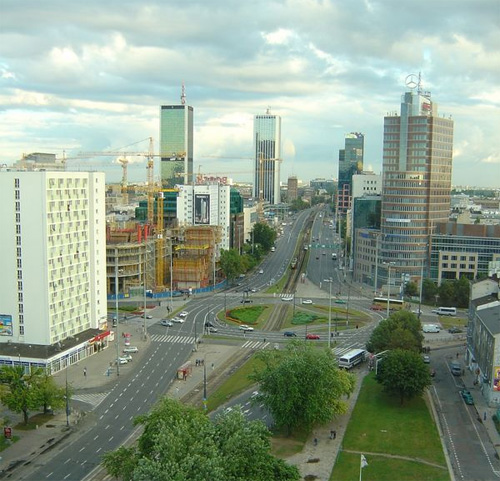
Also in Warsaw, which is now incredibly ‘westernized,’ one can find anything from Ikea, to Marks & Spencer, in the various malls and shopping areas of the city.

Local products to be found are antiques, hand-embroidered linens, glass or crystalware, leather goods, and of course the outstanding amber jewelry and objects made from this resiney substance. In the city of Warsaw visit the Nowy Swiat and Old town for antiques, and souvenirs.

In Warsaw the Blue City is making waves, because of the diversity of offerings under their blue domed roofs. Here you can shop for a car, entertain the kids in a theme park, eat, drink, and be merry. You can find the Blue City on Al. Jerozolimskie not far from Rondo Zesłańców Syberyjskich (near the Zachodni railway station). There is a tunnel giving access to the mall for people coming along Al. Jerozolimskie both from the city center, and from the Pruszków direction. There is parking available for 3000 cars.

In fact this is just one of literally dozens of malls that are springing up around Warsaw. Here you can go bowling, eat in a nice restaurant, shop, drop off the kids for playtime, and just relax. All in one environments designed to cost you money every step of the way like a good consumer.

List of Warsaw Malls:
Klif, Okapowa St.
Galeria Centrum, Marszafkowska St.
Galeria Mokotow, Woloska St.
Panorama, Witosa St.
Promenada, Ostobramska St., Grochow
Reduta, Jerozolimskie Av.
Reform Plaza, Jerozolimskie Av.
Sadyba Best Mall, Powsinska St., Sadyba

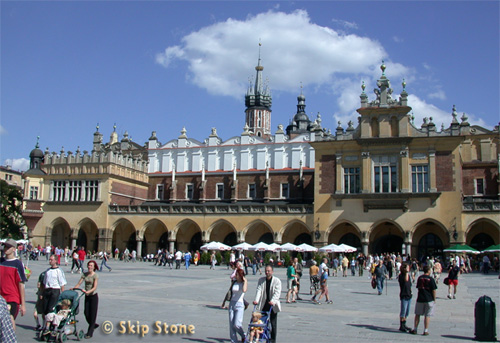
Krakow is far more interesting for the tourists to shop. In the authentic old town square is the amazing Cloth Hall, which we discuss in another article on architecture.

Here in Krakow looks for beautiful displays of amber jewelry, chess boards, pyramids and more. There are many different vendor stalls to explore in the Cloth Hall and adjacent alleyways. It’s the closest thing you’ll find to a souk in Northern Europe. Beautiful hand-made dolls, amazing lace tableclothes and pieces of lace for God-knows-what purposes and delightful wooden toys for the kids are displayed here.

In the buildings aroind Krakow’s old town square are designer shops, and antique stores galore. Here you can find everyone from Gucci to Versace and lots more…

Health Care in Poland for Travellers

If you work in Poland, you can easily bocome part of their Public Health Care system, by making deductions from your salary. Of course, you must have your work permit in order to become eligible. However, Eastern European medicine is not exactly up to Western standards, but can deal with the basic emergencies.

Here is a list of Hospitals, Doctors and Pharmacies of note:

Warsaw

Health Info Line (Information about health services)
Phone: (022) 26 27 61 or (022) 26 83 00

24-hour Service and Ambulance
ul. Hoza 56
Warsaw
Poland
Phone: (02) 628-2424

Continue reading

Banking in Poland

Banking in Poland is relatively easy for tourists with plastic. Just walk up to any ATM and get some zlotys, making sure they aren’t the old ones. Zlotys with dates earlier than 1995 are basically worthless.

Even though Poland has joined the European Union, it in not yet part of the European Monetary Union, and does not use the euro. The Polish would like to take the next step as soon as possible.

It is quite difficult to establish a bank account in Poland without residency, and this is even harder to obtain. So here is a list of the major banks in Poland worth dealing with – for credit card advances and transferring money.

Warsaw

American Express
ul. Krakowskie Przedmiescie 11
Phone: (02) 635-2002

Bank PKO Rotunda
ul. Marszalkowka 100/102
Phone: (02) 226 00 61

Bank Inicjatyw Gospodarczych
ul. Kopernika 36/40
Phone: (02) 657 5185

Bank PKO S.A
pl. Bankowy 2
Phone: (02) 637-1000

Krakow

American Express
al. Folcha 1
(in the Hotel Cracovia)
Phone: (012) 21 98 80 or (012) 22 46 32

American Express
Rynek 41
Phone: (012) 22 11 57

Bank PKO S.A.
Rynek 31
Phone: (012) 22 60 22

Emergency Telephone Numbers in Poland

Warsaw
Police emergency 997
Fire emergency 998
Ambulance 999
Police headquarters (022) 26 24 24

Krakow
Police emergency 997
Fire emergency 998
Ambulance 999
Police headquarters (012) 21 00 20 or (012) 10 71 15

Directory assistance (all of Poland): 913

Using the telephone in Poland can be a challenge, unless you are in a classy hotel. Working public telephones are few, especially in Warsaw. You must buy a prepaid telephone card to use the public phones, and this must be done in ADVANCE of your wanting to make a call. The machines do not take coins.

Too Much for One, Not Enough for Two

“Too much for one and not enough for two,” can be said about magnums of wine in France, and about half-liters of Vodka in Poland. Drinking in Poland is more than the national pastime; it’s part of the way of life here, and a rebellion from life itself. So don’t ever buy a half-liter of vodka in Poland. It is best to buy at least two liters.

Unbelievably, you can thank eighth-century Moroccans for alcohol; it was first distilled there. In the eleventh-century a vodka-like spirit was being created from wine in Italy, to the Italians it was known as aqua vitae or “water of life.”

At first alchemists kept the secret of distillation, and pharmacists came into existence to supply the masses with this elixir of health. It truly was a health aid in those days, killing bacteria in one’s drinking water was a necessity until modern times.

In fact the physicians and pharmacists of the day all agreed that getting drunk once or twice a month fortified the stomach and alcohol was often prescribed as a curative. As late as the nineteenth century two Polish physicians (a father and son) stated that: “to be healthy in Poland, pharmacies and doctors should not be used, but rather twice a year one should get properly drunk. Once in May instead with a mineral water cure, and the second time in October to avoid catarrh, pneumonia and phlogistic (inflammatory) diseases.”

Distilled spirits reached Poland from Italy or Germany in the 1600’s, and some of the distilleries operating in Poland today are direct descendants of these ancient businesses. Popular spirits consumed in Poland these days include Absinthe, Beer, Wine, and Vodka, with the Polish drinking substantially more wine than the average American. And as drinking is allowed at age 16 in Poland, it seems to be an integral part of the society, and may or may not be somewhat of a problem.

Paradoxically it seems the Polish have a reputation for being drunks, but only get drunk on special occasions. But any excuse seems to be enough to crack open that bottle of Vodka. What the Polish drink varies by economic class greatly. The comparatively rich city-dwellers import wines, liqueurs, and spirits of quality from abroad; and the working classes drink beer, cheap vodka and black-market spirits of dubious quality.

Drinking in Poland increased dramatically during the Communist era, when life was so grim, getting drunk was the only thing to look forward to. These days the Polish may drink less, but with a long tradition of being regarded as a healthful substance, it is still socially accepted. In fact there seems to be some scorn expressed by the average Pole for someone who doesn’t drink occasionally.

So when in Poland get out there and hoist a few, if you want to be accepted. It’s traditional!