The Paris Cookbook

The Paris Cookbook by Patricia Wells

Patricia Wells is the restaurant critic for the International Herald Tribune and has written other bestselling cookbooks. This book covers all the bases of French cuisine including entrees (starters), soups, salads, main dishes, breads, & desserts. If you like gourmet cooking, this book will tantalize your taste buds!

Notre Dame Cathedral

The legendary Notre Dame Cathedral sits on the right bank of the Seine River where even 2000 years ago it was a religious site. Construction began in 1163, and it was finally completed in 1345. It was badly defaced during and after the French Revolution when it was used as a warehouse.

A major restoration on the Cathedral was begun in 1841 after the publication of Victor Hugo’s “The Hunchback of Notre Dame”. Today the cathedral is undergoing a face lift, with centuries of grime being removed from the exterior, revealing a light beige stonework.

The immense gothic Cathedral can hold 6,500 worshippers, under the roof, which is 115ft (35 meters) high. The dark, enormous interior space is overwhelming.

The huge flying buttresses on the exterior were added in the 13th century to allow for bigger windows to let more light in. Some of the beautiful stained glass windows date back to that time. Evil looking gargoyles adorn the water spouts around the building.

Despite the huge numbers of tourists who visit the Cathedral, it makes for an interesting experience. You can get excellent views of Notre Dame from across the Seine river, and from the north tower (387 steps!) you can see up and down the river and over much of Paris.

Hours: Cathedral 8am-7pm Towers 9:30am-7:30pm
(Oct.-Mar. 10am-5pm).
Cost: Cathedral free entrance, Tower & Crypt €5.35
Phone: 01 42 34 56 10
Metro: Cité
Bus: 21,24,27,38,47,85,96

Thalys/TGV Rail Service

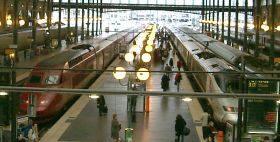
The sleek, high speed Thalys trains offer a quick way to reach other European cities from Paris. It’s only 1½ hours to Brussels and 4 hours to Amsterdam, which make it competitive with a plane trip, since you must also spend more time going through airport security and travel from the outlying airports to the city center.

A round trip to/from Amsterdam is about €107 in second class. Other cities served include Rotterdam, Antwerp, Köln, Aachen and Geneva. The service is so fast and reliable that you’ll get a partial to full refund if your train arrives at least 31 minutes late.

There’s no meal service with Comfort 2 (second class), but there is a bar car with overpriced and barely edible food. Comfort 1, (first class) offers snacks and a light meal on longer journeys depending upon the time of day. First class is more comfortable, and probably worth the extra money on a long haul.

For more info check out the Thalys website.

For rail journeys to other parts of France like Lyon and Marseille check out the TGV network. You can travel from Paris to Marseille in just 3 hours!

Paris Metro

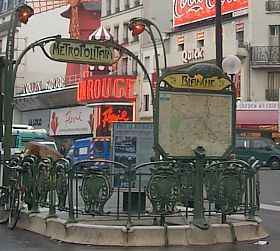
The first Paris Metro ran on July 19, 1900. Since then the system has expanded to 380 stations on 16 different lines, servicing the entire city. You’ll find a Metro station within 500 meters, no matter where you are in the city.

The famous Paris Metro is a very convenient, cheap and efficient way to get around. There are frequent trains during the day, and the last metros leave around 12:30am. A one-way fare is €1.30 Euros. You can also buy a book of ten tickets for 9.30 or a Paris Visite 1,2,3 or 5 day pass which is also valid on city buses, and gets you into first class on the SNCF trains which serve the suburbs. Price for the Paris Visite varies according to the number of zones and days.

Continue reading

Beware of Pickpockets!

This is a serious warning to all visitors to Paris that during your visit you will no doubt be scanned by pickpockets, whose deft hands will reach into your bag or pockets, determine if you have anything worth stealing, and make their getaway without you having a clue that you’ve been robbed.

It happens everyday, usually, but not always in crowded places like the metro, or in tourist attractions like museums, where you might think you’re safe. The pickpockets range from gypsy kids to well-dressed middle aged, professional men and women.

Continue reading

How to Use A Strippenkaart

The best way to pay for public transport in the Netherlands is to purchase a strippenkaart, available in most tobacco shops, post offices or any railway ticket office. These multiuse tickets allow travel on any city bus, tram or metro in Holland.

You must have these strips stamped when you board, either by using a yellow machine, or by the conductor in front or back of a tram or a bus conductor. To use the machine you fold over the kaart to the line you want stamped, and insert it into the horizontal slot until you hear the “ding.” The penalty for not having a valid ticket with stamp is around 30 Euros. And they do check when you least expect it!

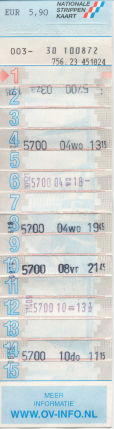
The most difficult part of the strippenkaart is figuring out the proper way to stamp it. As you can see in the sample at left, there are 15 spaces for stamps (A 45 space kaart is also available). If you are staying in the same zone, you need to have it stamped two lines down from the last stamp. Note the first row is in red, indicating that would not be valid stamp. Two lines is the minimum.

Now if your trip takes you out of your zone into the next one, you must stamp it 3 lines down. Likewise a trip involving 3 zones would require a stamp four lines down.

If you’re not sure how many zones you’re going, you can either look on a map which usually has the zones outlined. Or if you’re getting on a tram or bus you can tell the conductor your destination, and they’ll put the proper stamp. If you know how many zones your trip is, tell the conductor (one zone please) and they’ll make the appropriate stamp.

If you’re staying in Amsterdam’s Centrum, within the outer canal ring, it’s all one zone, so you just need to stamp it two lines down.

The stamp is good for one hour for one to three zones, longer if your trip takes you thru more zones. This info is on the back of the strippenkaart. So you could conceivably take a trip somewhere, do what you need to do, and return all with just one stamp! In addition the stamp includes any transfers even if you’re getting on another form of transport like bus to metro or tram.

So why bother with this? Well you’ll save money and hassle because the strippenkaarts (6.20 Euros for 7 short trips) work out to less than 1 Euro per trip, as opposed to about $1.30 or 1.40 Euros if you pay for each trip separately. You can also pay for your companion(s) using the strippenkaart, just stamp it more times for each person.

If you get to the end of your strippenkaart, and there’s just one space left, you can still use that (as every Dutch person would), by stamping that one, plus one line on another strippenkaart. That would equal the required two lines for a one zone trip, so you wouldn’t waste it!

If you’re a student or senior or get in on some discount plan, you can purchase monthly or yearly discounts, and you’ll get a photo ID so you don’t need to pay everytime, just flash your card. Discounted strippenkaarts available for those over 65 (with valid ID), students and children aged 4-11. These strippenkaarts have a red color.

If you’re still confused by all this (who isn’t?), you can go to this website and read ALL about it…