Hotelboat Ideaal

We had a great stay in this houseboat. It was absolutely amazing, comfortable and cosy. We enjoyed the fireplace a lot. Although we were there in December, it was pleasant on the boat, particularly with the heated water bed. It was windy and the water was choppy, but we never felt the boat move. I thought the location was fantastic…. Although we found all the stuff as it was written on the site we still really didn’t expect anything like this. The boat really gave me a feeling of home when I got back there at night. I am sure I want to back sometime in summer and enjoy the sun deck and barbecue.

Info:
for rent all year round

Tjin’s Toko

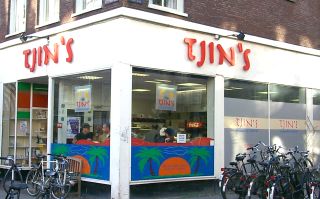
I discovered this little market by chance one day while shopping at the Albert Cuypmarkt. It didn’t look like a grocery store because the front is a take-away Asian place. But once you enter into the main shop (there’s two doors, one for the take-away), you’ll discover a treasure trove of hard-to-find grocery items from countries around the world.

The three very narrow aisles stock a wide range of products that will remind you of home. Or perhaps some exotic place you wish you could be. Like a good selection of Patak’s curry pastes and condiments, soy sauces including light and mushroom flavored, canned hummous and tahini, real hot jalapeño peppers from Mexico (not the mild Old El Paso ones, which they also carry), Betty Crocker cake mixes and frostings, Mrs. Dash salt-free seasonings, Phad Thai noodles, a good selection of beans, chocolate chips (very difficult to find in Holland, despite so much chocolate everywhere), and too much more to mention. You really need to see this place to believe it.

The manager is very good about locating and stocking items that you can’t find. My request for hummous was filled by my next visit!

The biggest drawback to this place is how cramped it is. You can barely work your way down these short aisles before someone tries to squeeze by. And the lack of space doesn’t leave much room for fresh produce, and the selection in the one cooler isn’t much.

Perhaps success will enable them to expand and increase their selection further. While the prices on some items are very reasonable, others like the cake mixes are expensive (7.50 euros is a lot for a mix that’s around $2.50 or less in the states). But if you’re jonesin’ for that special treat to remind you of home, you just might find it here!

I haven’t yet ventured into the take-away yet, but judging by how busy it is, I’d say it’s a good value.

Update: You might want to check the expiration dates on items before you purchase them, as I’ve noticed certain things that don’t sell remaining on the shelves for a very long time.

Phone: 020-671-7708
Tropenmuseum

Inside the Tropenmuseum you can stroll around the courtyard of a Javanese house, roam through noisy Arab streets, or find yourself in a thunderstorm in the middle of the African savannah. You may also relax to the authentic music of a South American jukebox – or listen to the gripping life story of a tropical rainforest-dweller.

Our visit coincided with the Batik exhibit showcasing the art form’s techniques, history and styles through the ages. Hundreds of examples of fine Batik, antique photos and dozens of displays showcase the regional origins of patterns, the different uses of Batik cloth, and more modern interpretations using the batik method.

I really appreciate the attitude of the museum and many exhibits, which review the negative impacts of human development upon these regions, and offer useful suggestions for preserving and restoring these ecosystems. This museum is highly recommended for tourists, students and children. In fact there’s a Children’s (Kinder) Museum too!

The Tropen Theater has excellent productions, showcasing ethnic music and culture from around the world, but like the museum, highlighting the former Dutch colonies of Indonesia, Suriname and the Netherlands Antilles.

Theater Museum

The Netherlands Theater Museum is on the Herengracht canal in the center of Amsterdam. Housed in five classic seventeenth-century buildings, the place is just a few minutes walk from the Dam Square.

The objective of the “Theater Instituut Nederland” is to make a significant contribution to the knowledge of, and opinion about, the Dutch theatre culture in an international context.

The Theater Institute provides information, conducts research, and initiates debate in relation to the needs and interests of theater professionals, and their audiences.

Sounds a little dry, but visiting the buildings are worth it for the architecture, as well as acquiring some knowledge of Dutch theater.

Info:
The buildings and the library are open from 11 am until 5 pm weekdays, and on Saturday from 1pm to 5 pm. Admission is 8.50 guilders.

Address:
168 Herengracht
Amsterdam 1016

Stedelijk Museum

The Museum is in a new beautiful building!

The Stedelijk Museum was founded in 1874 by a group of private citizens in Amsterdam, led by C.P. van Eeghen, who donated funds and their art collections to establish a museum in the capital of the Netherlands that would be devoted to modern art. The collection, housed at first at the Rijksmuseum, was moved in 1895 into the Museum’s own building, designed by A.W. Weissman.

For its first decades, the Stedelijk maintained a diverse collection, which included works of contemporary Dutch and French masters but also period rooms and even the banners of citizens’ militias. Beginning around 1920, however, the collection was culled and the focus concentrated more rigorously on modern and contemporary art, including pioneering collections and exhibitions of design and photography.

Already known to visitors from around the world because of its paintings by Vincent van Gogh (many of them later transferred to the Van Gogh Museum upon its creation), the Stedelijk began its rise to international prominence after 1945, when curator and designer Willem Sandberg became the Director. In addition to expanding the collection and working directly with many artists, Sandberg initiated an ambitious and far­sighted exhibition program that put the Stedelijk at the forefront of contemporary art institutions—a program that continued under Edy de Wilde (Director 1963– 1985), Wim Beeren (1985–1993), Rudi Fuchs (1993–2003) and Gijs van Tuyl (2005–2009) and that contributed greatly to the development of the Stedelijk’s collection.

Info:
The Stedelijk Museum is open daily from 11.00 am to 5.00 pm, and is closed on January 1.

Take the #5 or the Circle Tram from Centraal Station.

Underground parking and an underground Albert Hein (supermarket) are located next door.

Uffizi Gallery

The Uffizi Gallery is one of the most famous museums of paintings and sculpture in the world. Its collection of Primitive and Renaissance paintings comprises several universally acclaimed masterpieces of all time, including works by Giotto, Simone Martini, Piero della Francesca, Fra Angelico, Filippo Lippi, Botticelli, Mantegna, Correggio, Leonardo da Vinci, Raphael, Michelangelo and Caravaggio. German, Dutch and Flemish masters are also well represented with important works by Dürer, Rembrandt and Rubens.

The Uffizi Gallery is located on the top floor of the large building erected by Giorgio Vasari between 1560 and 1580 to house the administrative offices of the Tuscan State. The Gallery was created by Grand-duke Francesco I and subsequently enriched by various members of the Medici family, who were great collectors of paintings, sculpture and works of art. The collection was rearranged and enlarged by the Lorraine Grand-dukes, who succeeded the Medici, and finally by the Italian State.

The Uffizi buildings also house other important collections: the Contini Bonacossi Collection and the Collection of Prints and Drawings (Gabinetto Disegni e Stampe degli Uffizi).

The Vasari Corridor, the raised passageway connecting the Uffizi with the Pitti Palace, was built by Vasari in 1565. It is hung with an important collection of 17th-century paintings and the famous collection of artists’ Self-portraits.

We recommend you reserve your tickets in advance.  This is a very popular museum and you might wait for hours to get a ticket.

Source: Uffizi Gallery Website

Info:

Address:
Piazzale degli Uffizi
Firenze 50122

Phone: +39 0552388651

NEMO Science Museum

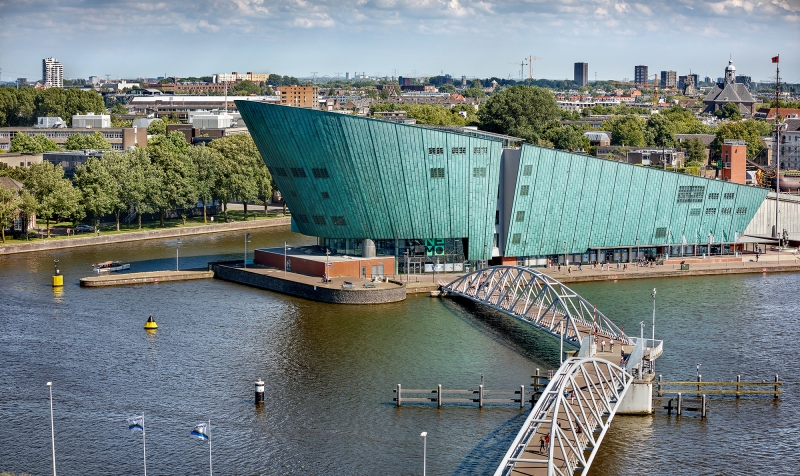
New Metropolis is the huge greenish hulk arising over the entrance to the Ij Tunnel leading north out under Amstedam’s harbor. N.E.M.O. as it is called here, is a technology museum, exhibition space, meeting center and venue for events. The building was designed by the Italian Renzo Piano, and it does look like some futuristic ship’s hull rising from the harbor of Amsterdam.

The highlight is the high technology museum, with an amazing display of interactive scientific wonders to delight all ages. Other exhibits come and go in the large interior.

Also here are a number of rooms for use by public and private organizations for conferences, parties, etc. The Glass Ballroom can hold up to 800 people, the NEMO theater seats 300, the Lumiere Filmhall seats 199, the Da Vinci Hall holds 80, the Columbus Foyer holds a maximum of 500 people, and the ultimately swanky “Captain’s Cabin” with it’s brass trim and nautical decor holds 25 very special guests. (They are currently asking around $1,000 per day to rent just this one room.) Of course, they’ll rent you the roof as well! Which I gather could hold up to 2000 revelers.

Scheepvaart Museum

>

The Scheepvaart Museum is the Netherlands Maritime Museum, located on Amsterdam’s harbor in the National Naval Depot, a former arsenal of the Dutch Navy that is over 300 years old.

The collection within tells the story of the maritime past of the Netherlands. Outside the Museum is a permanent berth for a replica of the Dutch East Indiaman “Amsterdam,” which is great fun to explore with guides in period costumes telling you about life aboard ship in the old days.

If you’ve got a binnacle at home, or a ship’s bell mounted somewhere, you’d be happy to spend hours wandering through this place. It’s fun even if you don’t have one.

Info:
Easy access by public transport: from Amsterdam Central Station 5 minutes by bus, line 22 or 32; or only a 15 minute walk.

Vakbondmuseum or the Stichting De Burcht

The Diamond Window

The Vakbondmuseum is also known as the Stichting De Burcht. You’re asking why?

Well this building is so interesting that if you have any interest in architecture that you must visit.

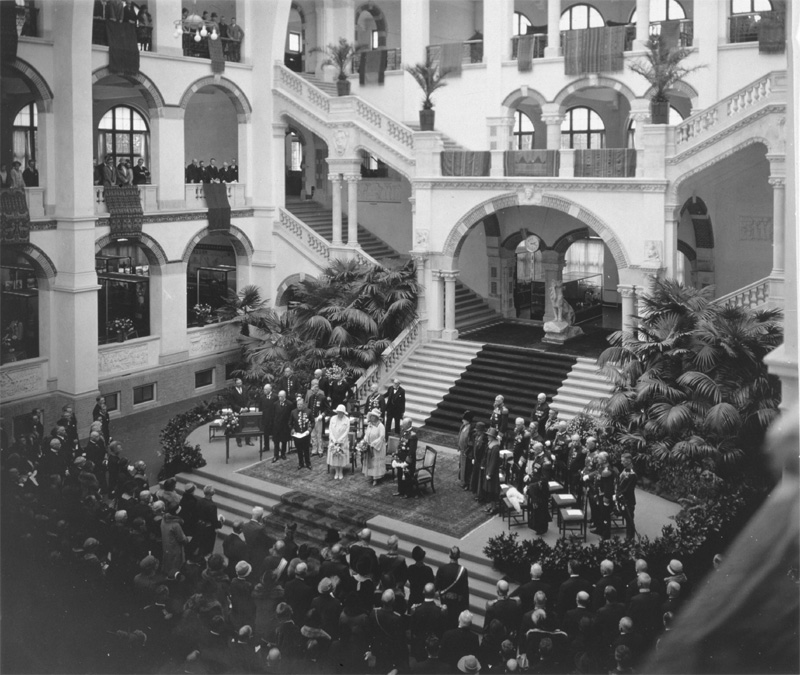
Designed by the founder of the Amsterdam school of Architecture, Hendrik Petrus Berlage (1856- 1934), who was a forceful figure on reshaping Amsterdam into what we see now in the 21st Century. The building was created for the thriving diamond industry whose capital was in Amsterdam at the time. Now the National Trade Unions Museum (or Stichting De Burcht) has its home here.

The museum’s website offers the following description: “Inside, you’re under the illusion that you have entered the covered courtyard of a Mediterranean palace. Sunlight streams down through a double roof of yellow and white glass and, passing through glass floor tiles, penetrates as far as the basement. The walls are of yellow, white and blue glazed brick and are relieved by vaults, columns and balustrades. An enormous hanging lamp high in the glass cupola, dominates the most beautiful of Amsterdam’s staircases. In the stylish rooms, you can enjoy paintings by Richard Roland Holst, stained glass windows, wooden panelling and furniture designed by Berlage himself. You can explore as high as the tower room that offers a view of the impressive cupola construction. In the high tower, you will see a lighted window pane in the form of a diamond.”

Museum Het Rembrandthuis

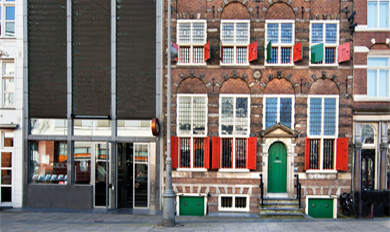
The facade of the Rembrandt House and Museum

The Rembrandthuis Museum is where the famous painter established his own studios here in Amsterdam, and lived with his family from 1639 to 1658.

He eventually left after declaring bankruptcy, and the home has been restored with approximations of it’s original furnishings based on an inventory of his possessions from that time.

Most of the building is devoted to his daily life from the time, and is of course, filled with paintings and art.

Part two of the museum is the new museum wing, where you will find exhibition rooms. The museum shop, the entrance to the museum café, the auditorium and the Rembrandt Information Centre are also located in the new wing.

On the fifth floor is the Rembrandt Information Center, where you can research on DC-rom, in books and other publications. By appointment only.