Vakbondmuseum or the Stichting De Burcht

The Diamond Window

The Vakbondmuseum is also known as the Stichting De Burcht. You’re asking why?

Well this building is so interesting that if you have any interest in architecture that you must visit.

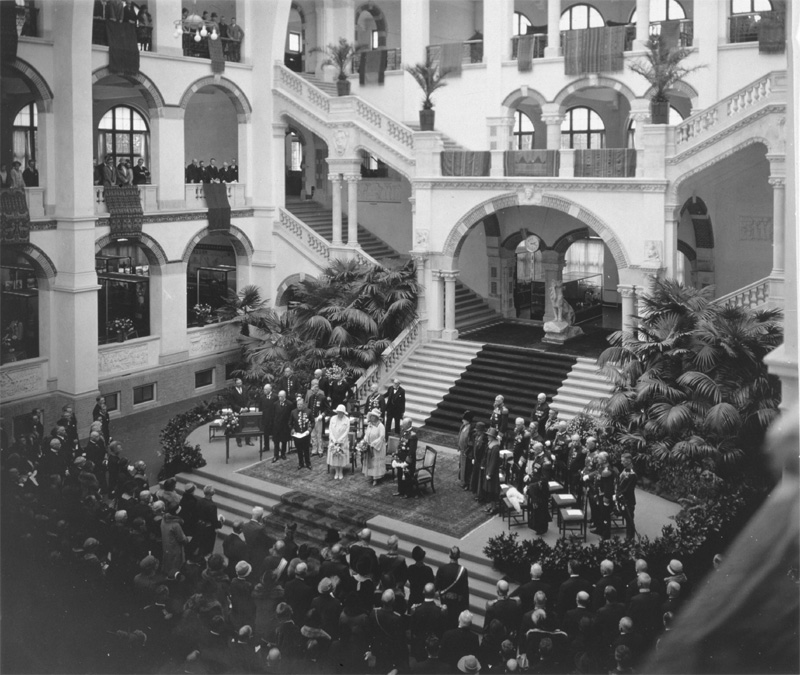
Designed by the founder of the Amsterdam school of Architecture, Hendrik Petrus Berlage (1856- 1934), who was a forceful figure on reshaping Amsterdam into what we see now in the 21st Century. The building was created for the thriving diamond industry whose capital was in Amsterdam at the time. Now the National Trade Unions Museum (or Stichting De Burcht) has its home here.

The museum’s website offers the following description: “Inside, you’re under the illusion that you have entered the covered courtyard of a Mediterranean palace. Sunlight streams down through a double roof of yellow and white glass and, passing through glass floor tiles, penetrates as far as the basement. The walls are of yellow, white and blue glazed brick and are relieved by vaults, columns and balustrades. An enormous hanging lamp high in the glass cupola, dominates the most beautiful of Amsterdam’s staircases. In the stylish rooms, you can enjoy paintings by Richard Roland Holst, stained glass windows, wooden panelling and furniture designed by Berlage himself. You can explore as high as the tower room that offers a view of the impressive cupola construction. In the high tower, you will see a lighted window pane in the form of a diamond.”

Scheepvaart Museum

>

The Scheepvaart Museum is the Netherlands Maritime Museum, located on Amsterdam’s harbor in the National Naval Depot, a former arsenal of the Dutch Navy that is over 300 years old.

The collection within tells the story of the maritime past of the Netherlands. Outside the Museum is a permanent berth for a replica of the Dutch East Indiaman “Amsterdam,” which is great fun to explore with guides in period costumes telling you about life aboard ship in the old days.

If you’ve got a binnacle at home, or a ship’s bell mounted somewhere, you’d be happy to spend hours wandering through this place. It’s fun even if you don’t have one.

Info:
Easy access by public transport: from Amsterdam Central Station 5 minutes by bus, line 22 or 32; or only a 15 minute walk.

NEMO Science Museum

New Metropolis is the huge greenish hulk arising over the entrance to the Ij Tunnel leading north out under Amstedam’s harbor. N.E.M.O. as it is called here, is a technology museum, exhibition space, meeting center and venue for events. The building was designed by the Italian Renzo Piano, and it does look like some futuristic ship’s hull rising from the harbor of Amsterdam.

The highlight is the high technology museum, with an amazing display of interactive scientific wonders to delight all ages. Other exhibits come and go in the large interior.

Also here are a number of rooms for use by public and private organizations for conferences, parties, etc. The Glass Ballroom can hold up to 800 people, the NEMO theater seats 300, the Lumiere Filmhall seats 199, the Da Vinci Hall holds 80, the Columbus Foyer holds a maximum of 500 people, and the ultimately swanky “Captain’s Cabin” with it’s brass trim and nautical decor holds 25 very special guests. (They are currently asking around $1,000 per day to rent just this one room.) Of course, they’ll rent you the roof as well! Which I gather could hold up to 2000 revelers.

Uffizi Gallery

The Uffizi Gallery is one of the most famous museums of paintings and sculpture in the world. Its collection of Primitive and Renaissance paintings comprises several universally acclaimed masterpieces of all time, including works by Giotto, Simone Martini, Piero della Francesca, Fra Angelico, Filippo Lippi, Botticelli, Mantegna, Correggio, Leonardo da Vinci, Raphael, Michelangelo and Caravaggio. German, Dutch and Flemish masters are also well represented with important works by Dürer, Rembrandt and Rubens.

The Uffizi Gallery is located on the top floor of the large building erected by Giorgio Vasari between 1560 and 1580 to house the administrative offices of the Tuscan State. The Gallery was created by Grand-duke Francesco I and subsequently enriched by various members of the Medici family, who were great collectors of paintings, sculpture and works of art. The collection was rearranged and enlarged by the Lorraine Grand-dukes, who succeeded the Medici, and finally by the Italian State.

The Uffizi buildings also house other important collections: the Contini Bonacossi Collection and the Collection of Prints and Drawings (Gabinetto Disegni e Stampe degli Uffizi).

The Vasari Corridor, the raised passageway connecting the Uffizi with the Pitti Palace, was built by Vasari in 1565. It is hung with an important collection of 17th-century paintings and the famous collection of artists’ Self-portraits.

We recommend you reserve your tickets in advance.  This is a very popular museum and you might wait for hours to get a ticket.

Source: Uffizi Gallery Website

Info:

Address:
Piazzale degli Uffizi
Firenze 50122

Phone: +39 0552388651

Stedelijk Museum

The Museum is in a new beautiful building!

The Stedelijk Museum was founded in 1874 by a group of private citizens in Amsterdam, led by C.P. van Eeghen, who donated funds and their art collections to establish a museum in the capital of the Netherlands that would be devoted to modern art. The collection, housed at first at the Rijksmuseum, was moved in 1895 into the Museum’s own building, designed by A.W. Weissman.

For its first decades, the Stedelijk maintained a diverse collection, which included works of contemporary Dutch and French masters but also period rooms and even the banners of citizens’ militias. Beginning around 1920, however, the collection was culled and the focus concentrated more rigorously on modern and contemporary art, including pioneering collections and exhibitions of design and photography.

Already known to visitors from around the world because of its paintings by Vincent van Gogh (many of them later transferred to the Van Gogh Museum upon its creation), the Stedelijk began its rise to international prominence after 1945, when curator and designer Willem Sandberg became the Director. In addition to expanding the collection and working directly with many artists, Sandberg initiated an ambitious and far­sighted exhibition program that put the Stedelijk at the forefront of contemporary art institutions—a program that continued under Edy de Wilde (Director 1963– 1985), Wim Beeren (1985–1993), Rudi Fuchs (1993–2003) and Gijs van Tuyl (2005–2009) and that contributed greatly to the development of the Stedelijk’s collection.

Info:
The Stedelijk Museum is open daily from 11.00 am to 5.00 pm, and is closed on January 1.

Take the #5 or the Circle Tram from Centraal Station.

Underground parking and an underground Albert Hein (supermarket) are located next door.
Theater Museum

The Netherlands Theater Museum is on the Herengracht canal in the center of Amsterdam. Housed in five classic seventeenth-century buildings, the place is just a few minutes walk from the Dam Square.

The objective of the “Theater Instituut Nederland” is to make a significant contribution to the knowledge of, and opinion about, the Dutch theatre culture in an international context.

The Theater Institute provides information, conducts research, and initiates debate in relation to the needs and interests of theater professionals, and their audiences.

Sounds a little dry, but visiting the buildings are worth it for the architecture, as well as acquiring some knowledge of Dutch theater.

Info:
The buildings and the library are open from 11 am until 5 pm weekdays, and on Saturday from 1pm to 5 pm. Admission is 8.50 guilders.

Address:
168 Herengracht
Amsterdam 1016

Tropenmuseum

Inside the Tropenmuseum you can stroll around the courtyard of a Javanese house, roam through noisy Arab streets, or find yourself in a thunderstorm in the middle of the African savannah. You may also relax to the authentic music of a South American jukebox – or listen to the gripping life story of a tropical rainforest-dweller.

Our visit coincided with the Batik exhibit showcasing the art form’s techniques, history and styles through the ages. Hundreds of examples of fine Batik, antique photos and dozens of displays showcase the regional origins of patterns, the different uses of Batik cloth, and more modern interpretations using the batik method.

I really appreciate the attitude of the museum and many exhibits, which review the negative impacts of human development upon these regions, and offer useful suggestions for preserving and restoring these ecosystems. This museum is highly recommended for tourists, students and children. In fact there’s a Children’s (Kinder) Museum too!

The Tropen Theater has excellent productions, showcasing ethnic music and culture from around the world, but like the museum, highlighting the former Dutch colonies of Indonesia, Suriname and the Netherlands Antilles.

Old Nickel Hotel Café and Restaurant

Perfect for the backpacking traveler who wants a little style and comfort while being right in the heart of all the fun in Amsterdam. The Old Nickel is just two minutes walk from Centraal Station, behind the imposing St. Nicklaas Cathedral, at

The style is unique, and the bar/lounge area is resplendent with ornate wood-carvings and paneling from the captain’s quarters of the 17th century sailing ship of Admiral Michiel de Ruyter. It was here that we chose to have a quiet beer one evening, after hammering our eardrums with a Grateful Dead cover band down an alley nearby. The smiling Dutch lady behind the counter served us beers quite cheerfully and bubbled with all sorts of advice. We retreated to a corner table and relaxed over a long conversation, and really enjoyed the place.

The guests arriving and departing seemed happy, and from pictures the rooms look a bit small, but offer a table and chairs in addition to beds. The room price includes a ham and eggs breakfast. The staff speak many languages, and seem to enjoy offering lots of help finding your way about town.

If you are interested in visiting Amsterdam soon, be sure to check out our all new HIP GUIDE TO AMSTERDAM HOTELS where you can search and book Amsterdam Hotels right here online!

Thanks to our association with Bookings® you can choose from hundreds of hotels in the Netherlands, and thousands more in Europe and around the world! We can also offer you special deals not found elsewhere!

Address:
Nieuwe Brugsteeg 11
Amsterdam 1012
Phone: 020 624-1912

De Engelbewaarder

de Engelbewarder (The Guardian Angel) Jazz Club and Bar

The name of this bar/cafe means “Guardian Angel”. Popular with the literati since the 70s it now serves up food and cool jazz music (on Sunday) to compliment the booze. The menu offers a good choice of items including appetizers like deep-fried calamari (recommended) and cheese fondue.

The canalside seating in nice weather is very popular, although you can’t really hear the music well from outside. Inside it’s usually very crowded, standing room only, and very smoky, especially on Sundays.
Good mix of people, Dutch regulars, expats, and some tourists. Sunday is the most popular day when jazz musicians jam from around 4pm to 7pm.

d’Vijff Vlieghen

This famous Dutch restaurant on the Spui, certainly oozes Old World charm.

A note from their website says: “I am Nicolaas the Fifth, born in 1627 and forgot to die. I am the King of the Five Flies’ Empire in Amsterdam, Holland. If you come to my Kingdom I will give you an experience you will never forget.” Promoted as founder Nicholas Kroese late 40s his Amsterdam Restaurant Five Flies in the United States, as he walked with a brass cage with five bronze flying in his hand on the street and with his charisma and impressive prevent the Americans made enthusiastic visiting his restaurant. Five Flies Restaurant exists today officially 75 years and has long been known worldwide as a must-do in Amsterdam. Especially in the United States has the restaurant a large group of fans. Enjoy good food with a good glass of wine in a unique and beautiful setting, which is where this restaurant is all about. A culinary museum is: Based in five pooled 17th century little houses, decorated in Old Dutch style with four original etchings by Rembrandt on the wall and walls lined with beautiful gold leather wallpaper from the 17th century.

We are ready for another 75 years, and hope we can welcome you soon to create a unique experience together with us!

On behalf of Restaurant d’Vijff Vlieghen, Albert Veerman, King of the Five Flies anno 2014

Info:
Open every day from 5:30 pm. Across the street from the Amsterdam Historical Museum. Reservations probably a good idea.